


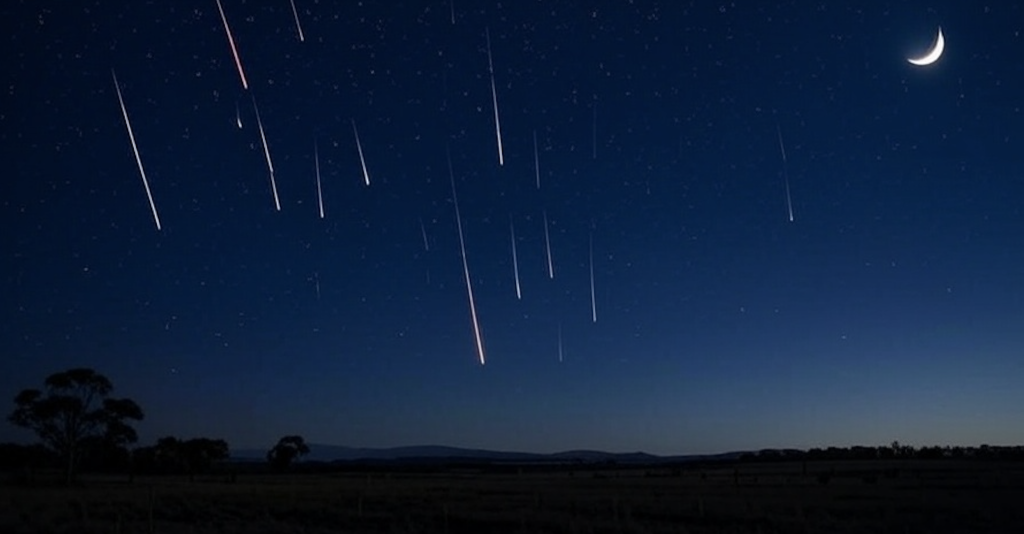
As the warm summer nights of late July envelop the globe, the cosmos offers a dazzling gift for stargazers: the simultaneous peak of two meteor showers, the Southern Delta Aquariids and the Alpha Capricornids, converging in a celestial display on the night of July 29-30, 2025. This rare double feature, accompanied by the early stirrings of the Perseids, promises a captivating show of shooting stars, especially for those willing to venture into the dark, pre-dawn hours. With a waxing crescent moon at just 27% illumination, conditions are near-ideal for spotting these fiery streaks across the sky. Here’s everything you need to know to catch this cosmic event and understand the science behind it.
A Tale of Two Showers
The Southern Delta Aquariids and Alpha Capricornids, though distinct in their characteristics, share the stage this week, creating a combined display of up to 25-30 meteors per hour under optimal conditions. Both showers originate from the debris trails of comets, those ancient wanderers of the solar system that shed dust and rock as they orbit the Sun. When Earth passes through these trails, the particles collide with our atmosphere at high speeds, burning up in brilliant flashes we call meteors or “shooting stars.”
The Southern Delta Aquariids, named for their radiant point near the star Delta Aquarii in the constellation Aquarius, are the more prolific of the two. Active from July 18 to August 21, this shower peaks around July 29-30, producing 15-20 meteors per hour in dark skies, particularly for observers in the Southern Hemisphere. These meteors, traveling at a medium speed of about 41 kilometers per second (25 miles per second), are often faint but can leave glowing, ionized gas trails that linger for a second or two. The shower’s parent body is believed to be comet 96P/Machholz, a 6.4-kilometer-wide comet discovered in 1986 by amateur astronomer Donald Machholz. This comet, part of the 96P/Machholz Complex, orbits the Sun every 5.3 years, leaving behind a trail of ancient dust, some 20,000 years old, that creates the Aquariids’ celestial fireworks.
The Alpha Capricornids, radiating from the constellation Capricornus near the star Alpha Capricorni, are a quieter affair, active from July 12 to August 12 and peaking alongside the Aquariids on July 29-30. Producing only about 5 meteors per hour, this shower compensates with quality over quantity. Its meteors, originating from comet 169P/NEAT (discovered in 2002), move more slowly at 24 kilometers per second (14 miles per second), often resulting in bright, colorful fireballs that can outshine the surrounding stars. These slow-moving streaks occasionally leave persistent trails, making them a favorite for those hoping to witness a “spectacular event” during a stargazing session, as noted by astronomer Nick Moskovitz of the Lowell Observatory.
Adding to the cosmic excitement, the Perseid meteor shower, one of the year’s most prolific, is already active in late July, contributing a few early meteors to the mix. Though the Perseids won’t peak until August 11-12, their presence enhances the night sky’s vibrancy, creating a triple-threat spectacle for keen observers.
How to Watch: Tips for a Stellar Experience
To maximize your chances of witnessing this celestial show, timing and location are key. The best viewing window is in the pre-dawn hours, between midnight and dawn, when the radiants of both showers are highest in the sky. For the Southern Delta Aquariids, look toward the southwestern part of the constellation Aquarius, just west of the bright star Fomalhaut, which can guide you to the radiant. The Alpha Capricornids’ radiant lies about 40 degrees west, near Capricornus. However, meteors can appear anywhere in the sky, so a wide, unobstructed view is ideal.
Observers in the Southern Hemisphere are in for the best show, as the radiants of both showers climb higher in the sky, offering clearer views and higher meteor rates. In the Northern Hemisphere, particularly in southern latitudes like the southern U.S., the showers are still visible, though the Aquariids’ radiant sits lower on the horizon, reducing the meteor count by about 50%. For example, at 40° north latitude, you might see around 10-12 Delta Aquariids per hour under dark skies.
Here are some expert tips to enhance your meteor-watching experience:
- Find Dark Skies: Light pollution from cities can drown out fainter meteors, so seek out rural locations or designated dark-sky sites. Apps like Dark Sky Finder can help locate the best spots.
- Be Patient: Allow your eyes 20-30 minutes to adjust to the darkness. Avoid looking at your phone or other bright lights, as they can ruin your night vision.
- Get Comfortable: Bring a blanket, sleeping bag, or reclining chair, and lie flat on your back to take in as much of the sky as possible. For the Aquariids, position yourself facing south, about halfway between the horizon and the zenith, and 45 degrees from Aquarius.
- Check the Weather: Clear skies are essential. Forecasts for July 29-30, 2025, suggest mostly clear conditions in many regions, though patchy clouds may affect parts of northern Europe and northwest England.
No Equipment Needed: Unlike stargazing for planets or galaxies, meteor showers are best enjoyed with the naked eye. Binoculars or telescopes narrow your field of view, reducing your chances of spotting meteors.
The waxing crescent moon, only 27% full on the peak night, will set before the radiants reach their highest point, minimizing light interference. This makes July 29-30 one of the best nights of the summer for meteor watching, as the Perseids’ peak in mid-August will be hampered by a nearly full moon.
The Science Behind the Spectacle
Meteor showers are more than just beautiful displays, they’re windows into the solar system’s history. The Southern Delta Aquariids and Alpha Capricornids result from Earth passing through debris trails left by comets millions of years ago. As these comets orbit the Sun, they shed particles ranging from dust grains to small rocks. When Earth encounters these trails, the particles enter the atmosphere at high speeds, heating up and ionizing the surrounding air to create the glowing streaks we see. Most meteors burn up completely before reaching the ground, but their fleeting brilliance tells a story of cosmic journeys.
The Delta Aquariids’ parent, comet 96P/Machholz, is part of a complex of eight meteor showers and related comets, all sharing a common origin. Discovered in 1986, this comet’s debris is estimated to be 20,000 years old, a testament to the longevity of these celestial trails. The Alpha Capricornids, meanwhile, stem from comet 169P/NEAT, a smaller body with a 4.2-year orbit. The slower speed of its meteors results from the relative motion of the comet’s debris trail and Earth, creating those striking fireballs that linger in the sky.
Interestingly, the Alpha Capricornids may grow more prominent in the future. Astronomers predict that in about 300 years, the debris trail’s gradual shift could transform this minor shower into a major annual event. For now, its fireballs remain a rare treat, with some reaching magnitudes brighter than Venus.
A Historical Perspective
The Southern Delta Aquariids have been observed since at least 1870, when Lt. Col. George L. Tupman recorded 65 meteors over the Mediterranean Sea, plotting their radiant in Aquarius. Later observations in the 20th century, including radio studies and the 1952-1954 Harvard Meteor Project, refined our understanding of the shower’s orbit and its connection to comet 96P/Machholz. The Alpha Capricornids, though less studied, have gained attention for their fireballs, with notable sightings reported as early as the 19th century.
These showers remind us that meteor watching is a blend of science and wonder, connecting us to the ancient rhythms of the solar system. As Thaddeus LaCoursiere of the Bell Museum in Minnesota notes, “Look for flashes of light in the night sky.” The combined effect of these showers, he adds, makes for “very nice classic meteor showers” that reward patient observers.
A Cosmic Invitation
The Southern Delta Aquariids and Alpha Capricornids offer a chance to pause and marvel at the universe’s grandeur. Whether you’re in the Southern Hemisphere, where the radiants soar high, or in the northern latitudes, scanning the southern sky for fleeting streaks, this double meteor shower is a reminder of our planet’s place in a dynamic cosmos. As the Perseids begin to sprinkle their own meteors into the mix, the night of July 29-30, 2025, promises a celestial trifecta that’s not to be missed.
So, grab a blanket, find a dark spot, and let your eyes adjust to the night. The sky is ready to put on a show, one that’s been 20,000 years in the making.