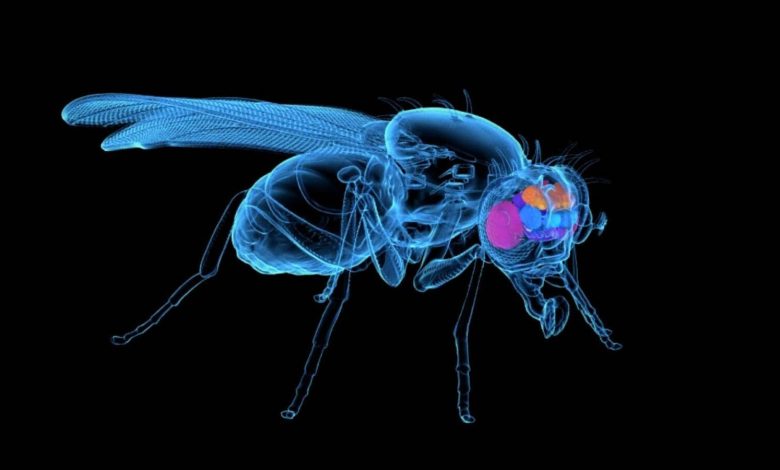
A San Francisco startup says it has done something long confined to science fiction: taken the complete wiring of a real animal’s brain, run it on a computer and let it control a body.
Eon Systems released a video on 7 March showing a virtual fruit fly exploring a sandpit, seeking out pieces of banana and stopping to groom itself. Alongside it, a constellation of points representing the fly’s brain flickers as the insect moves. Co-founder Alex Wissner-Gross shared the clip on X, calling it the “world’s first embodiment of a whole-brain emulation.” Days later, chief executive Michael Andregg put it more simply, posting that the company had uploaded a fruit fly.
If the claim holds up, it would mark the first time a whole-brain wiring diagram has been shown to drive several distinct behaviours in a body, rather than a single isolated reflex.
How it works
Eon did not map the brain itself. It built on FlyWire, a Princeton-led project that in 2024 completed the first full wiring diagram of an adult fruit fly brain, documenting 139,255 neurons and more than 50 million synaptic connections from electron microscope images.
That same year, researchers led by Philip Shiu, now Eon’s head of engineering, published a computational model in Nature that turned the FlyWire diagram into a working network. Each neuron in the model is highly simplified, firing when its excitatory inputs outweigh its inhibitory ones, yet the model correctly predicted which neurons drive feeding and grooming in real flies.
What Eon says it has added is a body. The company connected its brain emulation to NeuroMechFly v2, a physics-simulated fly body developed at EPFL in Switzerland, complete with compound eyes and antennae, running in Google DeepMind’s MuJoCo physics engine. Signals from the virtual world flow into the emulated brain, activity spreads through its connections, and the resulting motor commands move the body. The loop then repeats.
Andregg said the system reaches 91% behavioural accuracy using only the connectome’s wiring and simple neuron models, with “no hand-tuning, no additional learning algorithms.” The figure matches the prediction accuracy reported for the underlying brain model in Nature.
Why it matters
Most AI systems that imitate animal movement learn by training on huge amounts of data. Google DeepMind and others have trained neural networks to move virtual flies convincingly, but those networks bear no resemblance to an actual fly’s brain.
Eon’s pitch is the opposite. Instead of learning to behave like a fly, its system copies the structure of a real fly’s brain and lets behaviour emerge from that structure. If that approach scales, it would support a long-debated idea in neuroscience: that much of what a brain does is determined by how it is wired.
Eon has not been shy about where it wants to go next. The company says it is now gathering data for a full mouse brain emulation, roughly 70 million neurons and about 560 times the size of the fly’s. A human brain has around 86 billion.
The caveats
Not everyone is ready to accept the word “upload.” Within hours of the video spreading, fly neuroscientists began asking pointed questions on social media. One responded that extraordinary claims require “extraordinary evidence, not just cool visuals.”
Several open questions stand out. Eon has not yet published a paper or full technical details, and the work has not been peer reviewed. It is unclear how much of the walking and grooming on screen is generated by the brain model and how much by the body simulator, which was designed to walk and groom on its own and can be steered by external controllers. A real fly also relies on thousands of neurons in its ventral nerve cord, the insect equivalent of a spinal cord, to coordinate its legs, and it is not clear how Eon’s system handles that link.
The emulation also leaves out large parts of biology. It does not model neuromodulators such as dopamine and serotonin, which reshape how circuits behave depending on hunger, stress or illness, nor does it capture how synapses strengthen and weaken with learning. That means the virtual fly cannot form new memories.
None of this diminishes the scale of the engineering. Stitching together a whole-brain model and a physically realistic body into a single closed loop is a genuine technical feat. The question researchers want answered is whether the fly-like behaviour comes from the copied brain or from the body it was plugged into.
What comes next
Eon is expected to publish more detail on its methods. Independent researchers will be watching for one test in particular: whether the same body, connected to a random or scrambled network instead of the real fly connectome, behaves any differently. If the real wiring clearly outperforms the alternatives, the claim gets much stronger.
For now, the virtual fly is a striking proof of concept and a sign of how quickly connectome science is moving. Whether it is an upload, or a very sophisticated puppet with a real brain’s wiring attached, is a question the field is only beginning to argue about.