


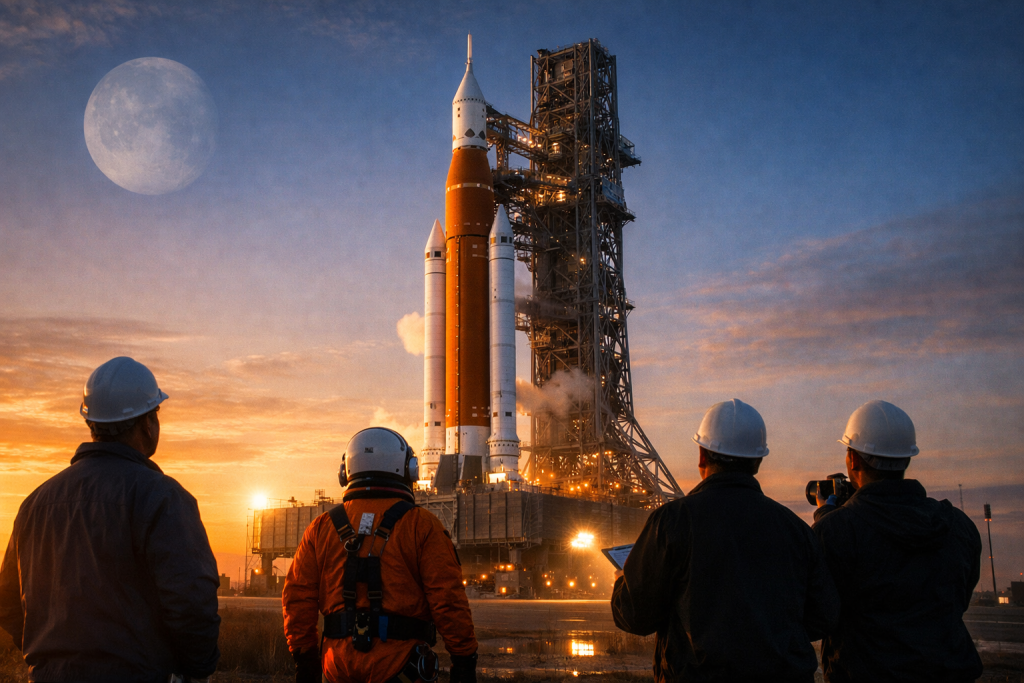
In a landmark achievement for modern space exploration, NASA’s Artemis II has carried humans farther into space than ever before, surpassing a record that stood since the Apollo 13 era. The mission, now on its return journey to Earth, marks a defining moment in the revival of deep space exploration and signals the dawn of a new lunar age.
Launched on April 1 aboard the towering Space Launch System, the crewed Orion spacecraft has completed a flawless journey to the Moon and back, executing a precision flyby that tested both human endurance and next generation spacecraft systems. Within days of launch, the mission had already entered the history books.
Record Breaking Journey Into Deep Space
At the heart of Artemis II’s achievement is distance. As the Orion spacecraft swept past the Moon’s far side, the crew exceeded Apollo 13’s long standing record, reaching more than 252,000 miles from Earth. For a brief but profound moment, these astronauts became the most distant humans in history.
The mission’s lunar flyby brought the spacecraft within roughly 4,000 miles of the Moon’s surface, offering unparalleled views of terrain never before observed directly by human eyes. During the passage behind the Moon, communications with Earth were intentionally severed for approximately 40 minutes, creating the longest planned blackout in crewed spaceflight history.
When contact resumed, the emotional weight of the moment was evident. The crew, including Reid Wiseman, Victor Glover, Christina Koch, and Jeremy Hansen, had just completed humanity’s most distant voyage.
A Mission Built on Precision and Legacy
From launch to lunar orbit, Artemis II has unfolded with remarkable precision. Early milestones, including translunar injection and life support activation, confirmed the readiness of systems that will underpin future missions.
The mission also carries deep symbolic weight. It is the first time humans have traveled beyond low Earth orbit since Apollo 17, reconnecting the present generation with a legacy that has defined human ambition for decades.
Inside the Orion capsule, astronauts conducted observations of the Moon’s far side, noting subtle geological variations and capturing imagery that will inform future landing missions. They also experienced a rare celestial alignment as the Moon briefly eclipsed the Sun from their vantage point in deep space.
Foundations for the Next Giant Leap
While Artemis II is a historic achievement in its own right, its broader purpose lies in preparation. The mission serves as a full scale test of the systems required for Artemis III, which aims to return humans to the lunar surface later this decade.
Data collected during the mission is expected to refine critical capabilities, including navigation, thermal protection, and long duration life support. These insights will play a central role in shaping not only lunar exploration, but also future missions to Mars.
The international dimension of Artemis II further underscores its significance. Hansen’s presence marks the first time a Canadian astronaut has ventured beyond low Earth orbit, highlighting the growing role of global partnerships in space exploration.
The Journey Home
With the lunar flyby complete, the Orion spacecraft is now on a carefully calculated return trajectory toward Earth. The mission’s final phase will include a high speed re entry and a complex splashdown sequence off the California coast.
NASA engineers are closely monitoring every system, gathering vast amounts of data that will inform future missions. The success of this phase will be critical in validating the spacecraft’s ability to safely return crews from deep space.
As Artemis II approaches its conclusion, its legacy is already secured. It has not only pushed the boundaries of human exploration but has also reignited a global vision for humanity’s future beyond Earth.
More than fifty years after Apollo, the message is unmistakable. The Moon is no longer a distant memory. It is once again within reach, and this time, humanity intends to stay.