


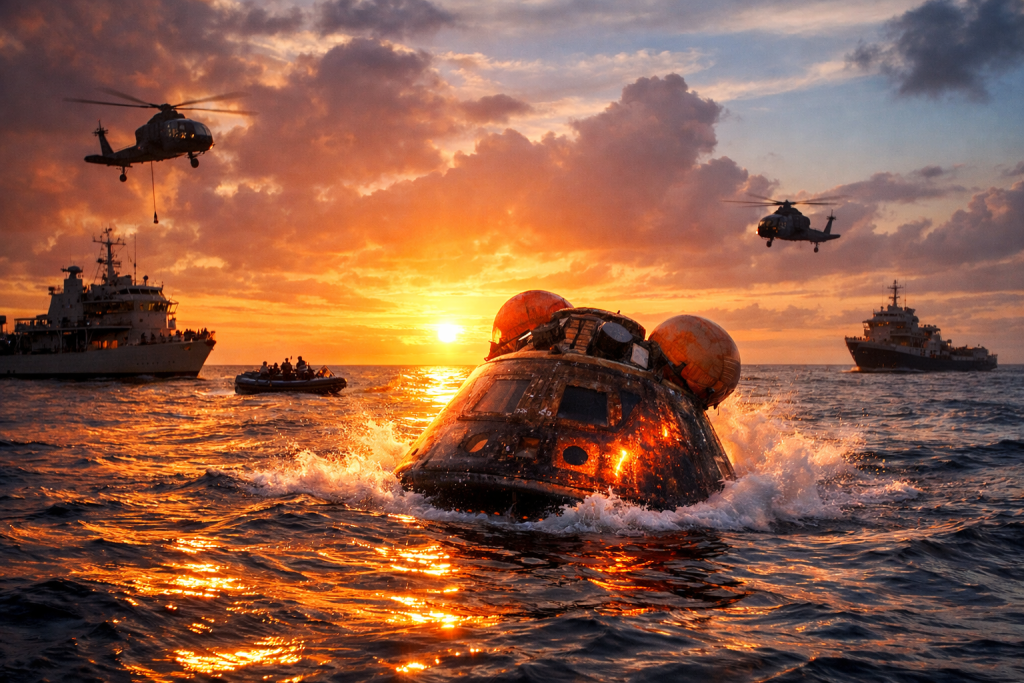
SAN DIEGO – The Artemis II crew, led by Commander Reid Wiseman alongside Victor Glover, Christina Koch, and Jeremy Hansen, returned to Earth Friday evening with a precise Pacific Ocean splashdown, closing a landmark mission that signals humanity’s renewed reach into deep space.


At exactly 8:07 p.m. EDT on April 10, NASA’s Orion spacecraft descended through Earth’s atmosphere and landed off the California coast, completing a ten-day mission that carried the crew farther from Earth than any humans have traveled before. Recovery teams aboard the USS John P. Murtha swiftly secured the capsule and confirmed all four astronauts were in strong condition following medical evaluations.
Launched from Kennedy Space Center on April 1 atop the Space Launch System rocket, Artemis II served as a full systems demonstration of NASA’s next-generation deep-space capabilities. The mission pushed Orion to a distance of more than 252,000 miles from Earth during its lunar flyby, surpassing records set during the Apollo era and reinforcing confidence in the spacecraft’s performance under extreme conditions.


As the spacecraft looped behind the Moon, Wiseman, Glover, Koch, and Hansen experienced an extended communications blackout lasting roughly 40 minutes, one of the longest in crewed spaceflight. During that period, the crew captured striking imagery of the Moon’s far side and Earth rising above the lunar horizon, images that have already resonated across the globe.
The journey included minor technical challenges, including a temporary issue with a waste management venting system, which the crew addressed using contingency procedures before engineers resolved the problem. NASA officials praised the astronauts for their adaptability and professionalism, noting that portions of the mission included manual control of the spacecraft to validate crewed flight operations.
“This crew performed exceptionally,” NASA flight director Judd Frieling said during mission briefings, emphasizing the importance of human oversight in future deep-space missions.
Though Artemis II did not attempt a lunar landing, its success is considered a critical step toward Artemis III, the mission intended to return humans to the Moon’s surface for the first time in more than half a century. NASA continues to target no earlier than 2027 for that milestone, which will aim to land astronauts at the lunar south pole and establish the foundation for sustained exploration.
NASA Administrator Bill Nelson, speaking from mission control in Houston, framed the achievement in broader terms. “This is the beginning of our permanent return to the Moon,” he said shortly after splashdown. “And it is the pathway to Mars.”
For Wiseman, Glover, Koch, and Hansen, the mission offered more than technical validation. Viewing Earth from lunar distance, the crew described a renewed sense of perspective on the planet’s fragility and unity. Hansen, representing Canada’s role in the program, called the journey “a shared step forward for humanity.”
With Orion safely recovered and the Artemis II crew en route back to Houston, the mission stands as a defining moment in modern spaceflight. After decades of absence beyond low-Earth orbit, human exploration has decisively returned to deep space, with the Moon once again at the center of global ambition.