Trump Brings Tech Titans to Beijing in High-Level Push to Reset US-China Relations

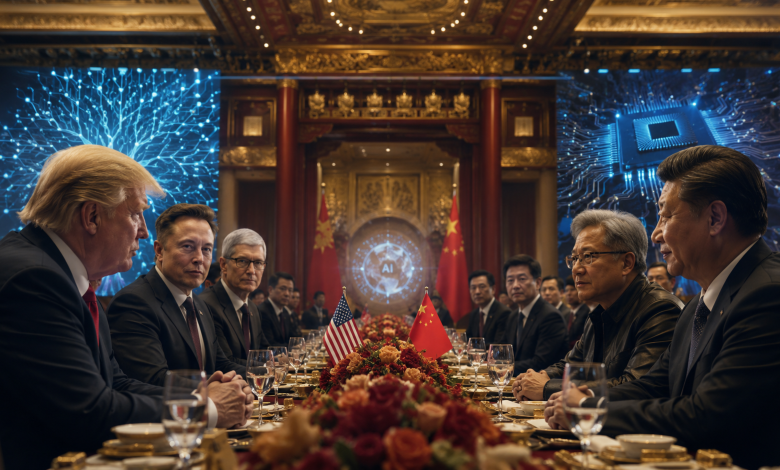
President Donald Trump arrived in Beijing this month with an unusually powerful delegation of American corporate leaders, signaling a renewed attempt to stabilize relations between the world’s two largest economies through a combination of diplomacy, trade, and technological cooperation.
Joining Trump aboard Air Force One for the May 13 to May 15 summit were some of the most influential figures in global technology, including Elon Musk, Tim Cook, and Jensen Huang. Their presence alongside Wall Street executives and industrial leaders transformed the state visit into a rare fusion of geopolitical strategy and corporate diplomacy.
The meetings with Chinese President Xi Jinping took place amid years of economic friction between Washington and Beijing, including tariffs, semiconductor export restrictions, and intensifying competition over artificial intelligence and advanced manufacturing.
Despite those tensions, the summit carried a noticeably softer tone than previous encounters between the two powers. Trump praised China as “an amazing country,” while Xi emphasized that China’s doors would “open wider” to American companies seeking investment and market access.
The inclusion of Musk, Cook, and Huang highlighted the extent to which technology now sits at the center of global diplomacy.
For Tesla, China remains a critical manufacturing and sales hub through its Shanghai Gigafactory, one of the company’s most strategically important facilities worldwide. Musk has maintained a uniquely influential position in China despite broader tensions between Washington and Beijing, often balancing political sensitivities with Tesla’s commercial ambitions.
Cook’s attendance underscored the continued importance of China to Apple. The company’s supply chain remains deeply intertwined with Chinese manufacturing, while the country also represents one of Apple’s largest consumer markets. The visit comes during a pivotal moment for Cook, with growing speculation surrounding leadership succession plans at Apple.
Meanwhile, Huang’s appearance drew particular attention given Nvidia’s central role in the global AI race. Nvidia has faced mounting pressure from U.S. export controls limiting the sale of advanced AI chips to China, making any diplomatic progress on semiconductor policy especially significant for the company and the broader technology sector.
Trump reportedly introduced each executive personally to Xi during meetings at Beijing’s Great Hall of the People, reinforcing the administration’s message that economic engagement remains a cornerstone of U.S.-China relations despite strategic rivalry.
Beyond the formal negotiations, the summit also produced moments that quickly spread across social media. Musk was photographed interacting with Cook and Lei Jun during a state banquet, while his son X attracted attention after appearing alongside delegates in several widely shared clips from the event.
Behind the carefully staged diplomacy, however, were substantive discussions on some of the most critical issues shaping the global economy.
According to reports surrounding the summit, both sides discussed supply chain stability, tariffs, investment flows, and the possibility of deeper cooperation on artificial intelligence safeguards. Officials also explored frameworks for future dialogue on risks tied to advanced AI systems, including cybersecurity and biological threats.
Although no major rollback of semiconductor export controls was announced, analysts viewed Huang’s participation as a sign that both governments may be exploring more targeted pathways for technology cooperation without fully abandoning national security priorities.
The summit also followed earlier agreements involving rare earth minerals and critical supply chains, areas where both nations remain heavily dependent on one another despite growing efforts to diversify production.
Market reaction to the visit was cautiously positive. Investors interpreted the summit as a signal that Washington and Beijing are seeking to reduce volatility and avoid further escalation that could disrupt global manufacturing and technology markets.
Shares connected to major multinational firms with significant China exposure, including Apple and Tesla, remained resilient as traders assessed the possibility of improved operating conditions and reduced geopolitical uncertainty.
Still, analysts cautioned that the visit represents more of a diplomatic reset than a comprehensive breakthrough. Deep disagreements over technology transfer, national security, and industrial policy continue to define the relationship between the two powers.
Yet the symbolism of Trump standing alongside America’s leading technology executives in Beijing sent a powerful message to global markets. Even amid strategic competition and ideological rivalry, the economic ties binding the United States and China remain too significant for either side to ignore.
For the global technology industry, the summit may mark the beginning of a more stable, though still highly competitive, phase in U.S.-China relations.