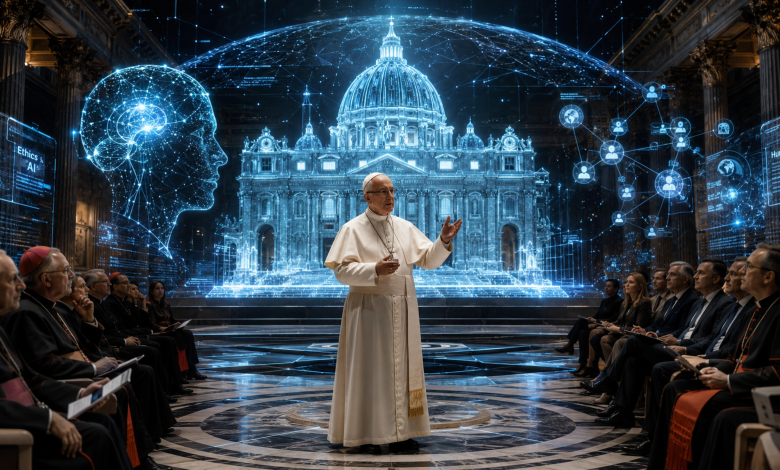
Pope Leo XIV has placed artificial intelligence at the center of the Vatican’s moral agenda, warning that humanity risks losing sight of its own dignity in an era increasingly shaped by algorithms and automation.
In his first encyclical, Magnifica Humanitas (“Magnificent Humanity”), released by the Vatican on May 25, the pontiff calls on governments, technology companies, and societies to ensure AI remains a tool that serves humanity rather than reshaping or diminishing it.
Subtitled On Safeguarding the Human Person in the Time of Artificial Intelligence, the document marks one of the strongest interventions yet from a global religious leader on the rapid rise of AI technologies.
The encyclical was signed on May 15, the 135th anniversary of Pope Leo XIII’s landmark social justice text Rerum Novarum, which addressed the societal disruption caused by the Industrial Revolution. Pope Leo XIV deliberately draws parallels between that era of industrial upheaval and today’s AI revolution.
The Pope said the world faces an “eclipse of the sense of what it means to be human” if technological development is pursued without ethical restraint and human-centered values.
While the Vatican acknowledged AI’s transformative potential in areas such as healthcare, education, creativity, and communication, the document repeatedly stresses that no machine can replicate the moral agency, spiritual depth, or relational nature of human beings.
A major focus of the encyclical is the growing concentration of technological power. Pope Leo XIV calls for stronger legal and ethical frameworks to prevent AI systems from deepening inequality, manipulating truth, or placing excessive influence in the hands of governments and corporations.
The document also sharply criticizes the use of AI in autonomous warfare and warns against allowing profit-driven incentives to dictate the future of advanced technologies.
The Pope further cautioned against transhumanist ideologies that blur the line between people and machines, arguing that human dignity cannot be reduced to data, optimization, or computational efficiency.
Beyond regulation, Magnifica Humanitas explores AI’s impact on employment, education, public discourse, and human relationships. The encyclical urges societies to protect meaningful work, preserve truth in the digital age, and strengthen community bonds amid growing technological isolation.
Drawing on biblical themes including the Tower of Babel and the rebuilding of Jerusalem under Nehemiah, Pope Leo XIV contrasts what he describes as a “culture of power” with a “civilization of love” rooted in solidarity, responsibility, and shared human flourishing.
The Vatican presented the encyclical alongside theologians, Church leaders, and technology figures including Christopher Olah, signaling an effort to engage directly with the AI industry rather than reject technological progress outright.
The document builds on previous Vatican AI initiatives including the Rome Call for AI Ethics and Antiqua et Nova, reinforcing the Church’s increasingly active role in global debates surrounding artificial intelligence governance.
The release arrives as governments and businesses worldwide race to deploy generative AI systems amid mounting concerns over job displacement, deepfakes, misinformation, and the long-term societal consequences of automation.
Rather than framing AI as inherently dangerous, Pope Leo XIV presents the technology as a test of humanity’s moral priorities.
“True progress flows from a heart open to others, an intelligence willing to listen, and a will that seeks what unites,” the Pope wrote.
With Magnifica Humanitas, the Vatican is positioning itself as a prominent voice in the global debate over whether AI will ultimately strengthen human civilization or erode the values that define it.