


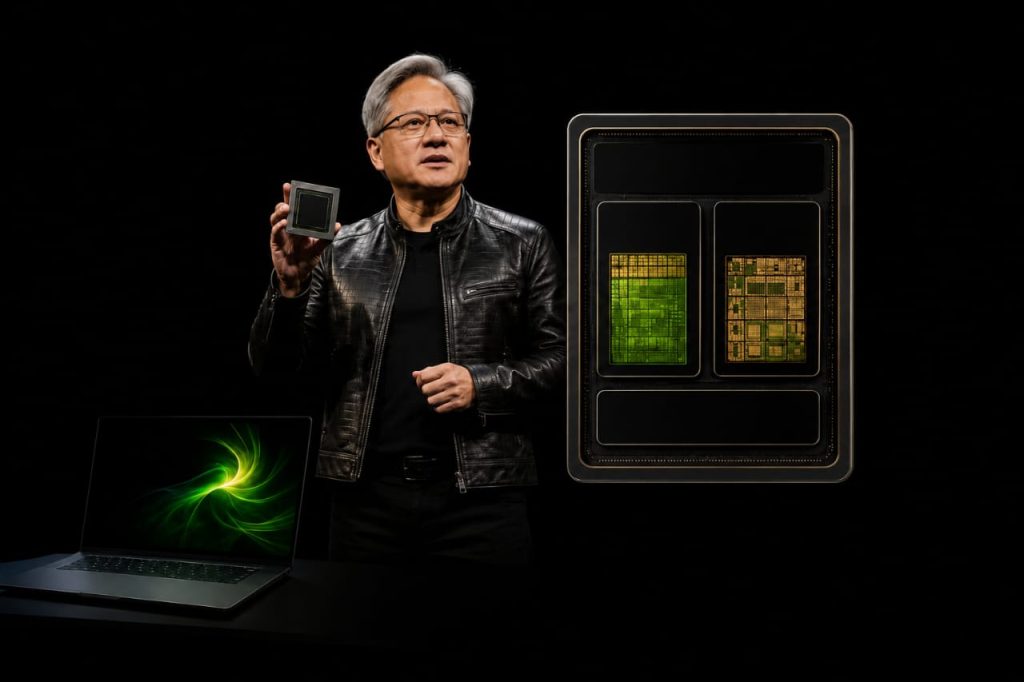
Nvidia CEO Jensen Huang opened Computex 2026 by introducing the RTX Spark superchip, a tightly integrated Arm-based CPU-GPU platform designed to power a new generation of high-performance, efficient Windows laptops and compact desktops.The launch positions Nvidia as a direct contender in the premium PC processor market and underscores the company’s strategy to bring advanced on-device AI capabilities to mainstream computing devices.
RTX Spark Superchip Specifications and Design
The RTX Spark combines two advanced chiplets connected via Nvidia’s high-speed NVLink-C2C interconnect:
GPU: Blackwell RTX architecture with 6,144 CUDA cores and fifth-generation Tensor Cores supporting FP4 precision.
CPU: Custom 20-core Nvidia Grace processor (Arm-based).
Memory: Up to 128 GB of unified memory.
AI Performance: Up to 1 petaflop of on-device AI compute.
This unified architecture enables coherent memory access and delivers strong efficiency for demanding workloads, including local AI agents, content creation, software development, and gaming with full support for Nvidia’s CUDA, RTX, DLSS, and Reflex technologies.
Strategic Partnerships and Availability
Nvidia has secured support from major OEMs and technology partners, including ASUS, Dell, HP, Lenovo, Microsoft, and MSI. Systems powered by the RTX Spark platform are scheduled to launch in fall 2026.
The announcement was closely coordinated with Microsoft, reflecting a shared vision for the future of Windows on Arm devices. Jensen Huang described the platform as the most significant evolution in personal computing in nearly four decades, aimed at transforming PCs from passive tools into intelligent, agentic systems.
Broader Implications
With the RTX Spark, Nvidia is leveraging its leadership in AI acceleration and graphics to expand its footprint in the traditional PC market. The platform is particularly positioned to meet growing demand for powerful local AI processing while maintaining strong performance-per-watt characteristics suitable for thin-and-light devices.
Additional details on next-generation roadmaps, including architectures based on Rubin, were also previewed, indicating continued investment in memory technologies such as LPDDR6 for future iterations.
What to Expect Next
Hands-on demonstrations and device prototypes are expected throughout Computex week. First commercial systems are anticipated in the second half of 2026, with independent benchmarks to follow closer to launch.