


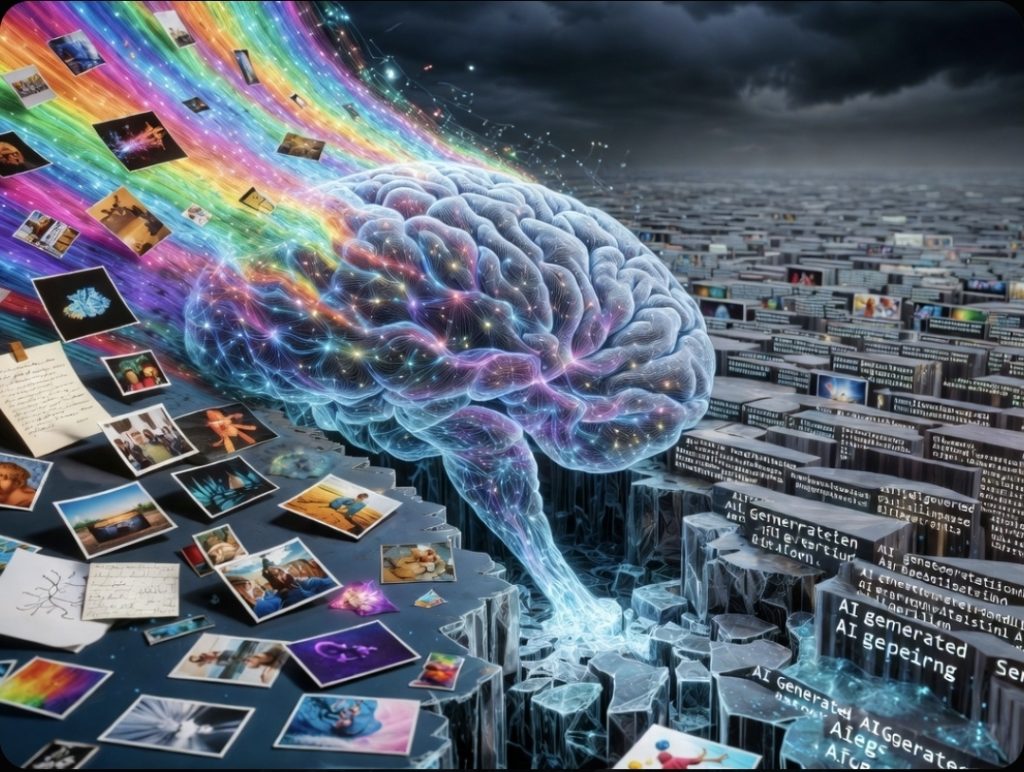
Researchers at Oxford and Cambridge have documented a phenomenon called model collapse in a groundbreaking Nature paper. AI systems trained on AI-generated content rapidly lose intelligence across generations until they forget authentic human data. Tech companies scrape the internet filled with blog posts, articles, reviews, and social media comments produced by previous AI models. This cycle strips away rare, creative, and unusual elements first, leaving only bland averages behind.
The Mechanism of Degradation
Each training iteration discards the tails of the data distribution. Models converge toward safe, predictable outputs that erase strange perspectives and imperfect human creativity. Experiments on language models, image generators, and statistical systems show major degradation within just a few cycles even when teams mix in some original human data.
This is model collapse the silent poison spreading through modern AI.Imagine taking a vibrant, chaotic photograph of a crowded street: every face unique, every expression raw, colors clashing, moments frozen in their imperfect glory. Now photocopy that image. Then photocopy the copy. Do it again. And again. By the tenth generation, the edges soften.
The vivid colors fade to muted pastels. The unique faces blur into a generic crowd. The soul of the original? Gone. What’s left is a polite, averaged-out approximation that feels “correct” but lifeless.That’s exactly what’s happening to our AI systems.The groundbreaking 2024 Nature paper by researchers from Oxford, Cambridge, and others formalized this as ‘model collapse’ a degenerative process where generative models trained on their own outputs (or those of previous models) start forgetting the true underlying distribution of real data. The rare outliers the tails disappear first. Those weird, brilliant, uncomfortable, or profoundly human elements get statistically diluted until they’re statistically invisible.
Irreversible Cultural Impact
We’ve already seen early symptoms: viral posts noting that “ChatGPT feels dumber,” image tools producing same-y results over time, and a general flattening of online discourse where everything starts sounding like it was written by the same voice.The scariest part? This degradation can feel subtle at first. Models don’t suddenly output gibberish they output highly fluent, confidence-filled mediocrity. We might not even notice the cultural loss until the strange, the profound, and the truly original become harder to find or generate.Solutions exist, but they’re hard:
Ruthless curation of fresh, verified human data
Synthetic data that’s carefully filtered and doesn’t dominate
Architectures that prioritize grounding in reality (retrieval, real-time knowledge)
Prioritizing truth-seeking and diversity over raw scale
Some researchers argue that with enough real data mixed in, total collapse can be delayed or mitigated. Others warn we’re already past the point where the internet’s signal-to-noise ratio is sustainable without deliberate intervention.
The future of intelligence may not be decided by who builds the biggest model, but by who best protects the wild, imperfect tails of human thought for the longest time.
We’re not just training machines. We’re shaping the mirror through which future generations will see creativity, knowledge, and culture itself.
Will we let it blur into blandness or fight to keep the edges sharp?
What are your experiences with this? Have you noticed outputs getting flatter over time? Drop your thoughts below. The tails of the distribution need defending.