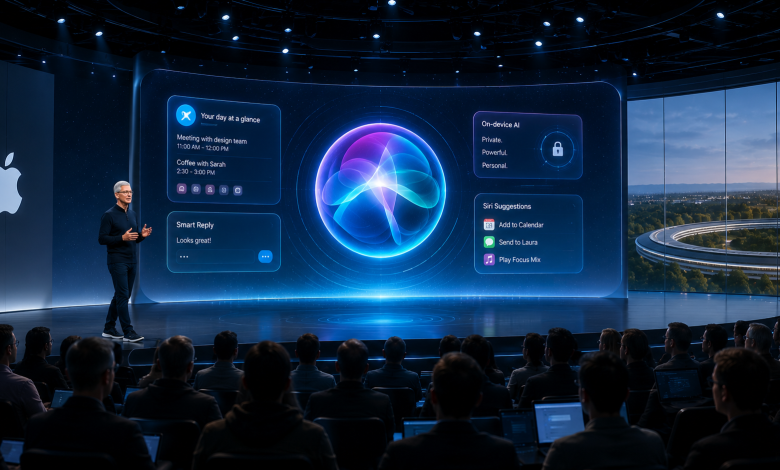
Apple has unveiled its most ambitious artificial intelligence strategy to date, placing a dramatically upgraded Siri at the center of its ecosystem as it attempts to close the gap with fast-moving rivals in the AI race.
At its annual Worldwide Developers Conference, the company introduced a reimagined Siri AI that moves far beyond its legacy as a voice assistant. The new system is designed to function as a deeply integrated, conversational intelligence layer across Apple devices, capable of understanding context, interpreting on-screen content, and executing complex, multi-step tasks.
This marks the most significant evolution of Siri in more than a decade and signals a decisive shift in Apple’s approach to artificial intelligence.
A Smarter, More Contextual Siri
The upgraded Siri introduces a standalone interface that more closely resembles modern AI chat platforms, complete with persistent conversations, file attachments, and richer interactions.
Its capabilities extend into what Apple describes as “on-screen awareness.” Users can highlight text within apps such as Mail or Messages and prompt Siri to take action, such as creating calendar events or summarizing content. Visual intelligence has also been enhanced, allowing the assistant to analyze real-world inputs through the camera in real time.
Perhaps most notably, Siri now operates across apps with far greater cohesion. It can draw information simultaneously from Messages, Mail, Photos, and Calendar to complete complex workflows in a single request.
Underpinning these features is a hybrid AI architecture that combines Apple’s on-device models with cloud-based reasoning systems, including integration with Google’s Gemini. The approach reflects Apple’s attempt to balance advanced capability with its long-standing emphasis on privacy.
Apple Intelligence Expands Across the Ecosystem
Beyond Siri, Apple previewed a broader expansion of its “Apple Intelligence” framework across core applications.
Safari gains improved tab organization and streamlined credential management. Messages and Phone introduce AI-assisted replies and contextual awareness during live conversations. Photos receives advanced editing tools, including spatial reframing and automated clean-up features.
Automation also takes a leap forward. Shortcuts and Home now support natural language commands, enabling users to create routines and manage smart home systems more intuitively. These updates collectively aim to make interactions feel less transactional and more adaptive to individual user behavior.
Refined Design and Performance Gains
Apple also continued to refine its Liquid Glass design language, enhancing readability and introducing new customization controls such as adjustable opacity levels. The visual updates focus on clarity and hierarchy, particularly as AI-driven features become more deeply embedded across the interface.
Performance improvements span iOS 27, iPadOS 27, and macOS 27, internally referred to as Golden Gate. Users can expect faster app launches, improved system search, and optimizations that extend support to older devices, including the iPhone 11.
Safety, Availability and Hardware Limits
The company emphasized safety alongside capability, introducing expanded parental controls and improved content filtering tools aimed at younger users.
Developer betas are available immediately, with public releases expected later this summer and a full rollout planned for the fall. However, some of the most advanced AI features will be limited to newer hardware, particularly the iPhone 15 Pro and later models. Regional availability will also vary, with certain features delayed in markets such as the European Union.
A Defining Moment for Apple’s AI Strategy
WWDC 2026 may ultimately be remembered as a turning point in Apple’s AI journey. While competitors like OpenAI and Anthropic have surged ahead with powerful standalone assistants, Apple is betting on deep integration, privacy, and ecosystem control as its differentiators.
The success of Siri AI will determine whether that strategy resonates with users who have increasingly turned to third-party tools for more advanced capabilities.
For Apple, the message is clear. The era of incremental updates is over. Siri is no longer just an assistant. It is now the centerpiece of the company’s fight to remain relevant in the age of artificial intelligence.