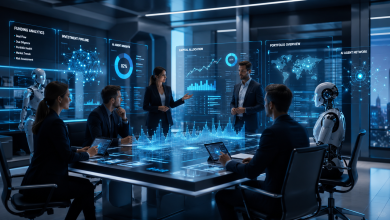
For decades, workplace automation followed a familiar pattern. Machines took over repetitive physical tasks, software streamlined paperwork, and computers helped employees work faster and more efficiently. Technology was largely seen as a tool, something people used to improve productivity rather than something that actively participated in the work itself. Today, however, the emergence of so-called AI employees is beginning to challenge that distinction, blurring the line between software that assists workers and systems that can perform work on their own.
Artificial intelligence is beginning to change that perception. Across industries, companies are deploying AI systems capable of answering customer questions, analyzing documents, conducting research, generating software code, summarizing meetings, and creating marketing content. Increasingly, businesses are discussing these systems not merely as tools but as digital workers. The concept may sound futuristic, but it is becoming a practical reality much faster than many expected.
The New Digital Workforce
What separates modern AI from previous generations of workplace technology is its ability to handle more complex forms of work. Traditional software followed strict instructions. AI systems, by contrast, can increasingly work from objectives. Instead of programming every possible scenario, companies can provide a goal and allow the system to determine how best to achieve it.
A modern AI assistant can review hundreds of documents, identify key information, draft communications, analyze data, and recommend actions in a fraction of the time it might take a human employee. As these capabilities improve, organizations are experimenting with what many in the industry call AI employees or AI agents. They are not employees in the legal sense, of course. They do not collect paychecks, request vacation days, or spend Monday mornings wondering why a meeting could not have been an email.
What they can do is perform increasingly sophisticated knowledge work. That distinction matters because knowledge-based professions were long viewed as relatively protected from automation. While robots transformed factories and software reshaped administrative tasks, many white-collar workers assumed their roles would remain largely insulated from the same forces. Artificial intelligence is challenging that assumption.
From Assistant to Coworker
Today, most AI remains firmly in the assistant category. Developers use it to write code faster, lawyers use it to review documents, marketers use it to generate content, and analysts rely on it to process large amounts of information. In these scenarios, humans remain in control while AI acts as a productivity tool.
That relationship may not stay the same for long. The next generation of AI systems is increasingly focused on autonomy. Rather than simply responding to prompts, AI agents are being designed to complete multi-step assignments independently. They can gather information, evaluate options, execute tasks within predefined limits, and deliver results with minimal supervision.
Imagine assigning an AI system the task of researching competitors. It gathers data, compiles findings into a presentation, schedules a meeting, and distributes the report to relevant stakeholders. What once required multiple software applications and several employees could potentially be handled through a single automated workflow. The employee does not disappear from the process, but the nature of the job begins to change.
As AI becomes more capable, workers may spend less time performing routine tasks and more time supervising systems that perform those tasks on their behalf. In many ways, the role shifts from doing the work to directing how the work gets done.
Businesses See Opportunity
It is not difficult to understand why companies are paying attention. Technology firms are investing billions of dollars into AI agents and workplace automation platforms, while startups focused on digital workers continue to attract substantial funding. Every major software provider appears to be racing toward the same goal: transforming AI from a helpful feature into a functional part of the workforce.
The business case is straightforward. Companies are constantly searching for ways to improve productivity, reduce costs, and scale operations. If AI can reliably handle routine work, employees can focus on higher-value activities such as strategy, creativity, customer relationships, and decision-making. At least, that is the theory.
The reality will almost certainly be more complicated. Workplace technology has a long history of promising simplicity before introducing entirely new forms of complexity. Anyone who has spent an afternoon troubleshooting a software update that was supposed to improve efficiency understands the pattern. Nevertheless, the economic incentives behind AI adoption remain powerful.
A Shift in Workplace Skills
One of the most significant impacts of AI employees may not be job replacement but job transformation. Throughout history, technological advances have often eliminated specific tasks while creating demand for new skills. Spreadsheet software reduced the need for manual calculations while increasing demand for financial analysis. The internet automated information distribution while creating industries that previously did not exist.
Artificial intelligence appears likely to follow a similar path. Employees who understand how to work alongside AI systems may become significantly more productive than those who do not. Skills such as designing workflows, managing AI agents, validating outputs, and evaluating automated decisions are already becoming more valuable.
In some organizations, employees may eventually find themselves managing small teams of digital workers alongside their human colleagues. Future job descriptions could include responsibilities that sound unusual today, such as supervising AI agents, auditing automated decisions, or coordinating hybrid human-AI workflows. Science fiction spent decades imagining robots replacing workers. Instead, many professionals may end up managing them through a browser tab.
Challenges Remain
Despite the excitement, AI employees are far from perfect. These systems can make mistakes, generate inaccurate information, misunderstand instructions, and occasionally produce results that leave users questioning whether the machine understood the assignment at all. Businesses adopting AI must also address concerns surrounding reliability, security, privacy, accountability, and governance.
There are broader economic questions as well. If AI systems become capable of performing more work, how will companies balance efficiency with employment? Which professions are most vulnerable to disruption? Which skills will become increasingly valuable? The answers remain uncertain, and experts continue to debate how significant the long-term impact will be.
History suggests technological revolutions rarely unfold exactly as predicted. Some fears prove exaggerated, some opportunities exceed expectations, and most outcomes land somewhere in the middle. The rise of AI employees will likely follow a similar path.
Looking Ahead
Artificial intelligence is unlikely to replace entire organizations overnight. Most businesses will adopt these capabilities gradually, automating one workflow at a time. The transition will probably look less like a dramatic takeover and more like a steady expansion of digital capabilities throughout the workplace.
What appears increasingly clear, however, is that AI is evolving beyond the role of traditional software. It is becoming something closer to a coworker. Whether businesses ultimately view AI agents as assistants, teammates, managers, or simply very sophisticated software remains to be seen.
For years, workers learned how to use software to do their jobs. The next generation of employees may spend just as much time learning how to manage software that does those jobs for them. And unlike most coworkers, AI never steals your lunch from the office refrigerator.