


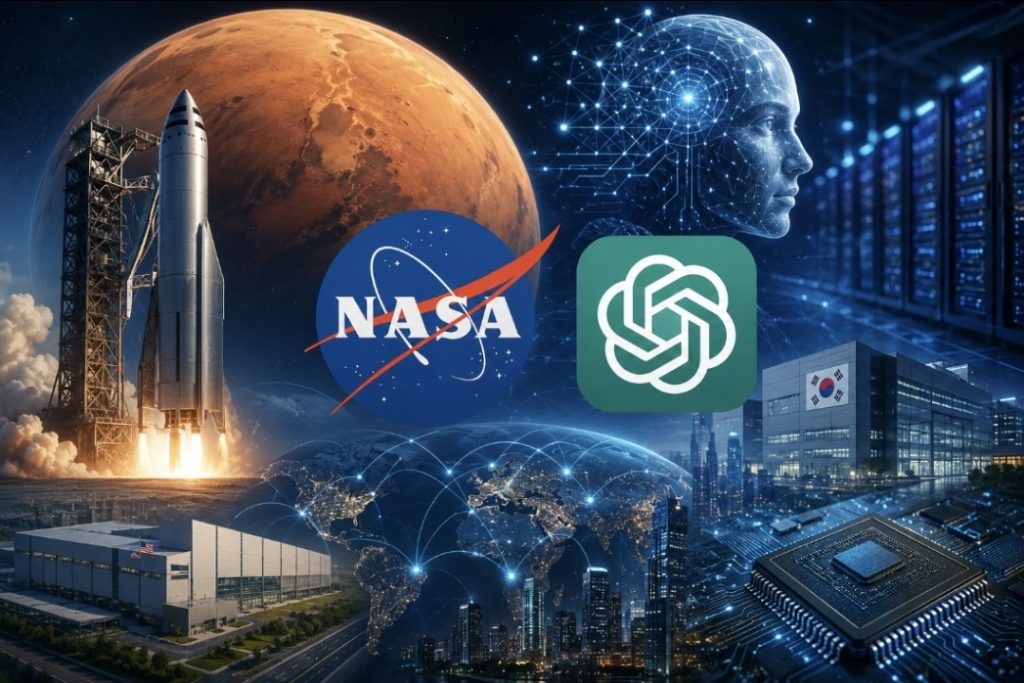
The global technology landscape continues to evolve rapidly as major developments emerge across space exploration, artificial intelligence, and semiconductor infrastructure. NASA has selected a rocket company backed by former Google CEO Eric Schmidt for a future Mars related mission, creating a new competitive dynamic in the commercial space sector. At the same time, OpenAI has strengthened its talent pool by attracting one of Google Gemini’s key leaders, while governments and technology firms across Asia and the United States continue investing billions of dollars into AI chips and computing infrastructure. Together, these developments highlight how competition for technological leadership now extends far beyond software and into space, hardware, and advanced computing systems.
NASA Expands Mars Ambitions with Eric Schmidt-Backed Rocket Venture
NASA’s decision to work with Eric Schmidt’s rocket company marks a significant development in the commercial space industry. The move positions Schmidt’s venture as a potential challenger to SpaceX, which has dominated discussions around Mars exploration and deep space transportation for years. By supporting additional private sector players, NASA aims to diversify its capabilities while encouraging innovation in spacecraft development, launch systems, and mission planning.
The selection also reflects NASA’s broader strategy of leveraging commercial partnerships to accelerate exploration goals. As interest in Mars missions grows, the agency continues to seek new technologies that can reduce costs, improve reliability, and expand mission flexibility. Schmidt’s involvement brings considerable financial resources and technological expertise, potentially creating a stronger competitive environment that could benefit future exploration efforts. The emerging rivalry between established aerospace leaders and new entrants may play a crucial role in shaping humanity’s long term presence beyond Earth.
OpenAI Strengthens Its Position in the AI Talent Battle
Competition in artificial intelligence has intensified as OpenAI reportedly recruited a co lead from Google’s Gemini project. The move underscores the fierce battle for top AI researchers and engineers as companies race to develop more advanced language models and intelligent systems. Talent has become one of the most valuable assets in the AI industry, with organizations willing to invest heavily to secure expertise capable of driving breakthrough innovations.
The transition also highlights the growing competition between OpenAI and Google, two of the industry’s most influential players. Both companies continue pushing the boundaries of generative AI, multimodal systems, and enterprise applications. As AI adoption expands across industries, leadership teams increasingly view strategic hires as essential to maintaining a competitive edge. The movement of high profile researchers between organizations demonstrates how rapidly the AI ecosystem is evolving and how critical human capital has become in determining future market leadership.
AI Infrastructure Race Accelerates Across Asia and the United States
Beyond talent and software development, the battle for AI dominance increasingly depends on computing power. Governments and private companies throughout Asia and the United States continue expanding investments in semiconductor manufacturing, AI accelerators, and large scale data center infrastructure. These investments support the growing computational demands of advanced AI models, which require vast amounts of processing power for training and deployment.
Major technology firms are securing access to next generation chips while also expanding cloud infrastructure to meet rising demand from enterprises and consumers. Countries across Asia are strengthening domestic semiconductor capabilities to reduce dependence on foreign suppliers, while U.S. companies continue scaling data center operations to support increasingly sophisticated AI workloads. This infrastructure race has become a strategic priority because access to advanced chips and computing resources now plays a central role in determining technological competitiveness. As AI applications become more powerful and widespread, investments in hardware and infrastructure will likely shape the future balance of power within the global technology industry.