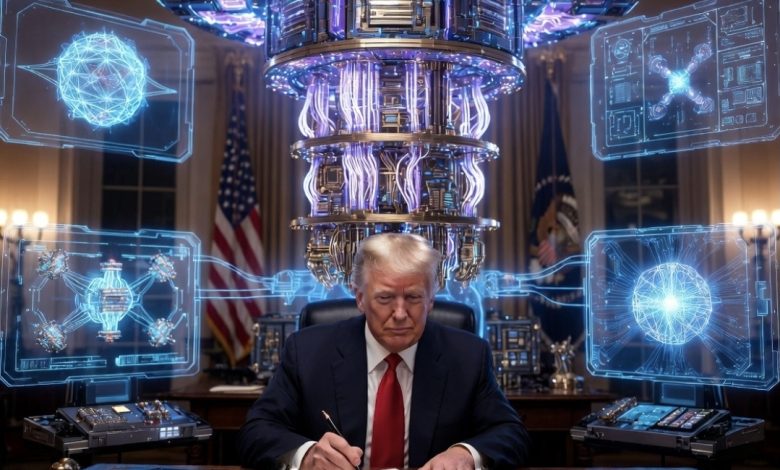
President Donald Trump has signed two major executive orders aimed at accelerating America’s leadership in quantum technology while strengthening national cybersecurity against emerging digital threats. The initiatives mark one of the most significant federal commitments to quantum computing and post quantum security in recent years, as the United States intensifies efforts to compete with China in advanced technology development and protect critical digital infrastructure from future cyber risks.
Executive Orders Launch New Era for Quantum Technology
The first executive order, titled “Ushering in the Next Frontier of Quantum Innovation,” directs federal agencies, including the Department of Energy and NASA, to advance the development of a powerful quantum computer capable of supporting scientific discovery and commercial innovation by 2028. The order also requires government agencies to accelerate quantum sensor deployment within the next five years, strengthen domestic quantum supply chains, and expand workforce training programs to support the growing demand for quantum technology professionals.
The administration views quantum technology as a strategic national priority capable of transforming industries ranging from artificial intelligence and healthcare to advanced manufacturing and financial services. Officials believe the initiative will help drive commercialization, stimulate economic growth, create high paying technology jobs, and reinforce America’s position as a global leader in emerging technologies. The order builds upon the National Quantum Initiative Act signed in 2018, which established the foundation for federal quantum research and development programs.
Federal Government Accelerates Post Quantum Cybersecurity
The second executive order, “Securing the Nation Against Advanced Cryptographic Attacks,” focuses on protecting federal systems and critical infrastructure from future threats posed by quantum computers. The directive mandates an accelerated transition to post quantum cryptography, requiring federal agencies to migrate key systems and high value digital assets to quantum resistant encryption standards between 2030 and 2031. The order also establishes a pilot migration program that federal authorities plan to complete by the end of 2027.
Security experts have warned that sufficiently advanced quantum computers could eventually break many of the encryption methods currently used to secure government networks, financial systems, communications platforms, and sensitive data. The administration’s strategy seeks to address the growing “harvest now, decrypt later” threat, where adversaries collect encrypted information today with the expectation of decrypting it once quantum computing capabilities mature. Federal agencies will now develop detailed migration plans and adopt standards approved by the National Institute of Standards and Technology to ensure long term protection of critical information assets.
Quantum Race With China Drives Strategic Investment
The executive orders arrive amid increasing global competition in quantum computing, particularly between the United States and China. The White House believes quantum technologies will play a crucial role in national security, scientific advancement, economic competitiveness, and technological leadership. Alongside quantum computing development, the administration plans to expand research into quantum networking, sensing technologies, and advanced applications that could reshape industries and strengthen defense capabilities.
The broader initiative also carries significant implications for digital asset security, financial markets, and critical infrastructure protection. With hundreds of billions of dollars in digital assets relying on cryptographic security, including an estimated $449 billion in Bitcoin related value referenced by industry observers, policymakers view quantum resistant security measures as increasingly important. By combining quantum innovation with cybersecurity modernization, the administration aims to position the United States at the forefront of the next technological revolution while protecting sensitive government and commercial data from future threats.