


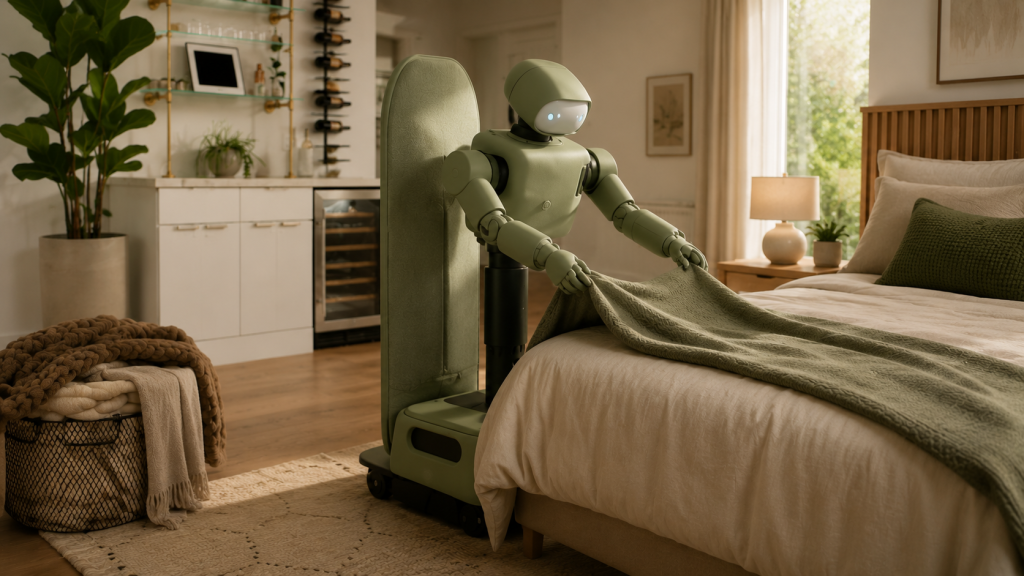
Weave Robotics has officially introduced Isaac 1, a consumer-focused home robot designed to automate everyday household tasks such as folding laundry, making beds, and tidying living spaces.
Announced by the San Francisco-based startup on Thursday, the robot is scheduled to begin shipping in Fall 2026, with initial availability focused on customers in California before expanding across the United States.
Unlike many humanoid robots aiming to perform a wide range of industrial and commercial tasks, Isaac 1 takes a different approach by focusing on practical chores inside the home.
Designed for Everyday Living
Isaac 1 features a soft fabric exterior and a minimalist design intended to blend naturally into modern homes.
Instead of walking on two legs, the robot uses a wheeled base for greater stability and efficiency while navigating indoor environments.
Its adjustable body allows it to extend from approximately 3 feet to nearly 6 feet tall, enabling it to reach shelves, beds, and laundry baskets while remaining compact when not in use.
The company says the design was inspired by furniture rather than traditional robotics, making the device feel less intrusive in everyday living spaces.
Built Around Household Tasks
Rather than trying to replace every human activity, Isaac 1 specializes in repetitive chores that consume time each day.
According to Weave Robotics, the robot can:
- Collect dirty laundry around the home
- Sort and fold clothing
- Put clean clothes away
- Make beds and arrange pillows
- Organize shoes, toys, and household clutter
- Assist with general room tidying
The robot is managed through a companion mobile app, allowing users to schedule cleaning routines or manually control specific tasks.
For situations the onboard AI cannot fully resolve, Isaac 1 can connect to remote human operators who provide teleoperation assistance, helping ensure tasks are completed successfully.
The company also plans to deliver regular over-the-air software updates that expand the robot’s capabilities over time.
Hardware and Pricing
Isaac 1 is equipped with a battery capable of providing up to eight hours of operation on a single charge and requires approximately two hours to recharge.
The robot offers:
- Adjustable height up to 80 inches
- 33-inch horizontal reach
- Compact wheeled mobility
- Autonomous navigation
- Mobile app integration
Customers can purchase Isaac 1 for $7,999 or subscribe through a monthly plan priced at $449.
Pre-orders require a fully refundable $250 deposit.
Building on Isaac 0
The launch follows the company’s earlier Isaac 0, a stationary robot focused primarily on laundry folding.
According to Weave Robotics, Isaac 0 has already accumulated thousands of operating hours in customer homes, providing valuable real-world data used to improve the new mobile platform.
The company believes Isaac 1 represents the next step toward practical home robotics capable of handling everyday responsibilities rather than experimental demonstrations.
Competition in Home Robotics
The unveiling comes as competition in consumer robotics continues to intensify.
Companies including Tesla, Figure AI, and several emerging robotics startups are developing increasingly capable humanoid systems designed for homes, warehouses, and manufacturing facilities.
Rather than pursuing general-purpose humanoid intelligence, Weave Robotics is focusing on solving a smaller number of common household problems with a purpose-built machine.
That strategy could appeal to consumers seeking immediate utility instead of futuristic promises.
Challenges Ahead
While Isaac 1 introduces several practical innovations, questions remain about affordability, real-world performance, and adoption.
Its wheeled platform may limit mobility in homes with stairs or uneven surfaces, and its premium price places it beyond the reach of many households.
The long-term success of the platform will likely depend on how reliably it performs everyday tasks and whether future software updates significantly expand its capabilities.
What Comes Next?
Weave Robotics plans to begin delivering Isaac 1 to California customers later this year before expanding nationwide in 2027.
As AI-powered robotics rapidly moves from research labs into consumer homes, Isaac 1 represents another milestone in the growing effort to make intelligent household assistants a commercial reality.
Whether specialized robots like Isaac 1 outperform broader humanoid platforms remains one of the biggest questions shaping the future of home automation.