


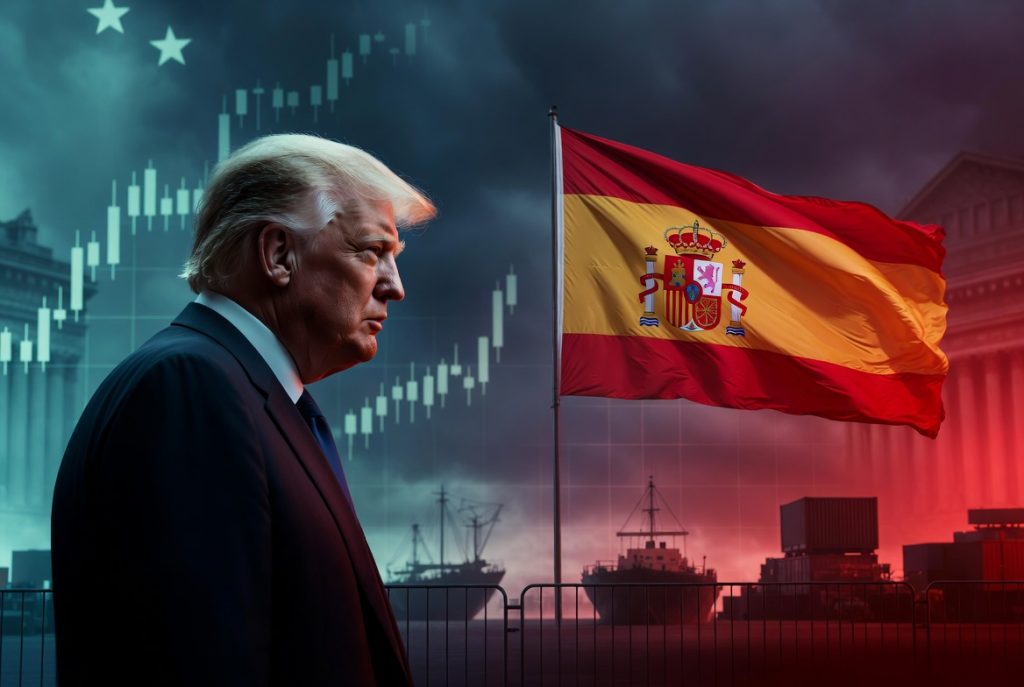
President Donald Trump has ordered the United States to cut off all trade with Spain, marking one of the sharpest economic confrontations between Washington and a major European ally in recent years. The announcement came during the NATO summit in Ankara, where Trump criticized Spain over defense spending commitments and its position on military cooperation with the United States. The decision immediately sparked concerns across financial markets, international trade circles, and diplomatic communities as investors assessed the potential impact on transatlantic commerce and supply chains.
NATO Dispute Triggers Major Trade Action
Trump linked the move directly to Spain’s refusal to support the alliance’s new defense spending targets and disagreements surrounding U.S. military operations in the Middle East. The U.S. president described Spain as an unreliable NATO partner and instructed Treasury officials to begin preparations aimed at ending commercial relations between the two countries. The comments added further strain to relations between Washington and Madrid at a time when geopolitical tensions continue to reshape global trade patterns.
Spain’s government responded cautiously, emphasizing that trade negotiations involving member states fall under the authority of the European Union rather than individual national governments. Spanish officials also highlighted the long-standing economic relationship between the two nations and expressed confidence that diplomatic channels could help reduce tensions before any formal restrictions take effect.
Markets Watch Potential Impact on Global Trade
The United States and Spain maintain significant trade ties across sectors including agriculture, automotive manufacturing, pharmaceuticals, technology products, and industrial equipment. Any disruption to this relationship could affect exporters, importers, logistics companies, and multinational corporations operating on both sides of the Atlantic. Analysts also warned that broader European Union responses could amplify the economic consequences if negotiations fail to produce a compromise.
Financial markets closely monitored developments following Trump’s announcement, although investors largely adopted a wait and see approach while awaiting formal policy measures. Trade experts noted that implementing a complete cutoff could face legal, regulatory, and diplomatic challenges because Spain operates within the European Union’s common trade framework.
Global Businesses Brace for Diplomatic Fallout
The dispute highlights growing pressure within NATO over defense spending and burden sharing among alliance members. It also reflects the increasing use of trade policy as a geopolitical tool in international relations. Businesses with exposure to U.S. European commerce are now reviewing supply chains and contingency plans as uncertainty surrounding future policy direction continues to build.
Economists expect negotiations between Washington, Madrid, and European Union officials to continue over the coming weeks as all parties seek to avoid a prolonged economic confrontation. The outcome could influence future trade policy discussions between the United States and its European allies while shaping investor sentiment across global markets.