


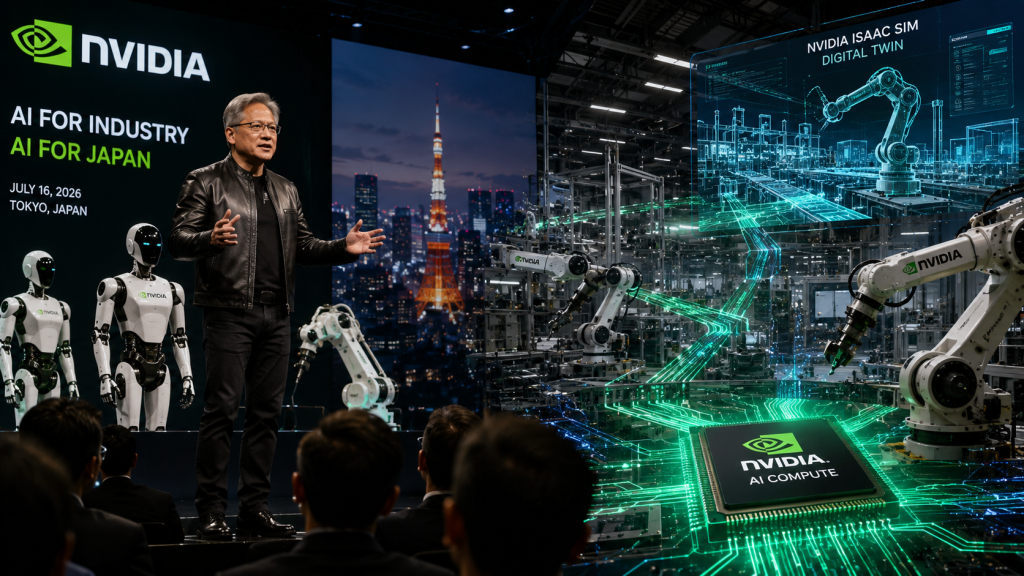
Nvidia has announced a series of strategic partnerships with some of Japan’s largest robotics and manufacturing companies, strengthening its push into physical AI and intelligent automation.
The collaborations with FANUC, Yaskawa Electric, Fujitsu, and Kawasaki Heavy Industries aim to accelerate the development of next-generation robots capable of perceiving, reasoning, and operating autonomously in real-world environments.
The announcement was made during Nvidia CEO Jensen Huang’s visit to Tokyo, where he outlined the company’s vision for AI-powered robotics transforming industries ranging from manufacturing to logistics and healthcare.
Nvidia Brings Physical AI to Industrial Robotics
Speaking at a media briefing in Tokyo, Huang emphasized that artificial intelligence is redefining the capabilities of modern robots.
“With AI, robots will become smart, easily adaptable and accessible.”
The partnerships combine Nvidia’s AI software and hardware ecosystem with Japan’s decades of expertise in industrial robotics.
Together, the companies plan to develop more intelligent automation systems capable of learning, adapting, and operating with greater efficiency than traditional factory robots.
FANUC and Yaskawa Integrate Nvidia AI
Among the biggest announcements were expanded collaborations with FANUC and Yaskawa Electric, two of the world’s leading industrial robotics manufacturers.
The companies will integrate Nvidia technologies including:
- Isaac Sim for digital twin simulations
- Cosmos world foundation models
- Jetson edge AI computing
- Metropolis AI vision platform
Using Nvidia’s simulation tools, manufacturers can test and optimize robotic production lines in virtual environments before deploying them in real factories, reducing costs while improving efficiency.
Building Japan’s AI Infrastructure
Nvidia also announced deeper cooperation with Fujitsu and Kawasaki Heavy Industries to support broader AI infrastructure and robotics initiatives.
The partnerships extend beyond manufacturing into sectors such as:
- Smart mobility
- Logistics automation
- Shipbuilding
- Industrial AI
- Edge computing
A government-backed initiative involving Noetra, supported by investors including Sony, also plans to acquire 27,500 Nvidia Rubin AI chips to develop sovereign AI foundation models optimized for robotics applications.
The move reflects Japan’s ambition to strengthen domestic AI capabilities while reducing dependence on foreign AI ecosystems.
Why Japan Matters
Japan has long been recognized as a global leader in robotics, deploying millions of industrial robots across automotive, electronics, and manufacturing sectors.
However, the country is increasingly investing in AI-driven automation to address workforce shortages caused by its aging population while maintaining global competitiveness.
By combining advanced robotics with generative AI and simulation platforms, Japanese manufacturers hope to create machines capable of handling more complex and dynamic tasks.
Jensen Huang Draws Attention in Tokyo
Huang’s visit attracted significant attention across Japan’s technology industry.
During the trip, he met with executives from several semiconductor and technology companies, including supply chain partners, while also participating in government meetings focused on AI development.
His public appearances generated enthusiastic crowds, reflecting Nvidia’s growing influence as demand for AI infrastructure continues to surge worldwide.
The Bigger Picture
The partnerships further strengthen Nvidia’s position beyond AI chips and cloud infrastructure.
The company is increasingly building a complete ecosystem that combines:
- AI processors
- Robotics software
- Simulation platforms
- Digital twins
- Autonomous systems
- Edge computing
As industries worldwide race to automate physical work using artificial intelligence, Nvidia is positioning itself as a foundational technology provider for the next generation of intelligent machines.
What’s Next?
The collaborations are expected to accelerate the deployment of AI-powered robots across manufacturing, logistics, healthcare, and transportation over the coming years.
With Japan serving as one of the world’s most advanced robotics markets, Nvidia’s latest partnerships could become a blueprint for how physical AI is deployed globally.
As artificial intelligence moves beyond chatbots and into factories, warehouses, and industrial systems, the future of robotics may increasingly be powered by Nvidia’s growing AI ecosystem.