


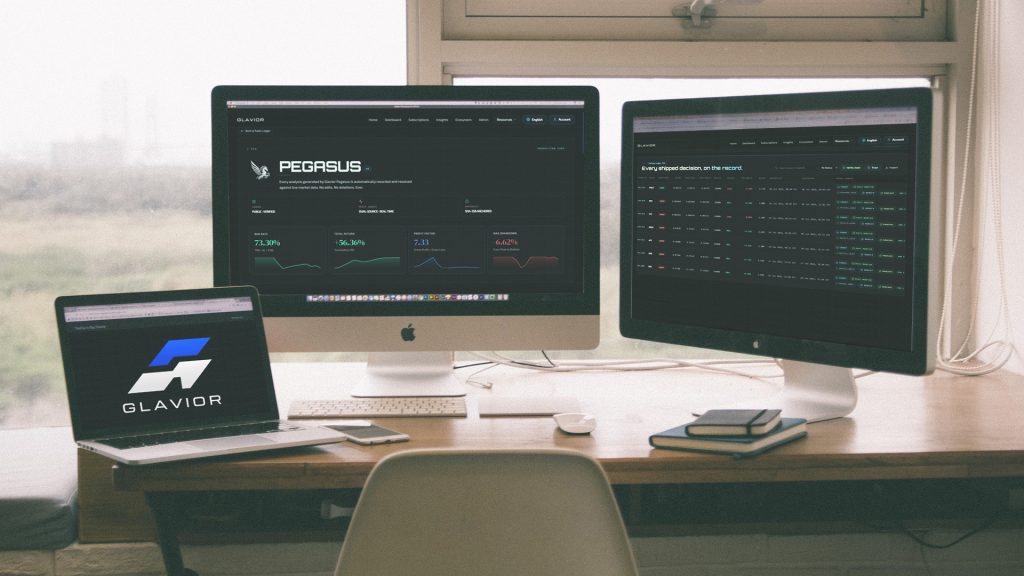
From earning online at nine to developing a global financial technology platform without a traditional team, Tanishq Saluja’s journey shows how AI is changing who can build ambitious software, but not what it takes to make it real.
When most nine-year-olds wanted to buy something online, Tanishq Saluja was trying to understand how people made money there.
He had no startup capital, no audience, and no bank account of his own. What he did have was access to online communities and the willingness to study how attention, digital products, distribution, and internet businesses worked.
With his father’s permission to receive payments through his account, Saluja began participating in online communities and finding ways to turn digital opportunities into small amounts of income.
At twelve, he started TSS Market, an online business selling digital products and services to customers internationally. Saluja independently managed product creation, outreach, customer acquisition, marketing, payments, support, and day-to-day operations. He continued running the business until 2024.
It was not a conventional route into entrepreneurship, but it gave him something many founders spend years trying to develop: direct experience convincing strangers on the internet to trust, purchase from, and return to a product.
By thirteen, Saluja had also started trading financial markets.
By fifteen, he had generated approximately $40,000 across online businesses, freelancing, and trading.
He later lost approximately the same amount through trading. That failure became the starting point for Glavior.
A Loss That Became a Product


“Every mistake looked different at the time,” he said. “When I looked back, they came from the same problem. Too much noise, not enough filtering, and too many decisions made emotionally.”
Instead of searching for another indicator or another person to follow, Saluja began thinking about the system he wished he had used.
That question became Glavior, a financial intelligence and non-custodial execution platform designed to help retail traders determine which market opportunities deserve attention and which should be ignored. Saluja began exploring the idea in February 2025. Serious development of the complete platform began in October of that year.
He was fifteen.
Building Without a Traditional Team
A product like Glavior would ordinarily require several specialized functions.
A conventional team might include frontend and backend engineers, database specialists, artificial intelligence researchers, financial-market analysts, infrastructure engineers, designers, security specialists, and product operators.
Saluja did not have that team.
He began building the platform himself through AI-assisted research and development, repeated experimentation, and months of testing different market-analysis approaches against live market data.
The resulting Glavior includes:
- AI-assisted market intelligence
- Structured trade plans
- Paper trading
- Portfolio tools
- Chart and candlestick pattern detection
- Whale intelligence
- Non-custodial exchange execution
- A publicly inspectable performance ledger
- Support across 18 languages
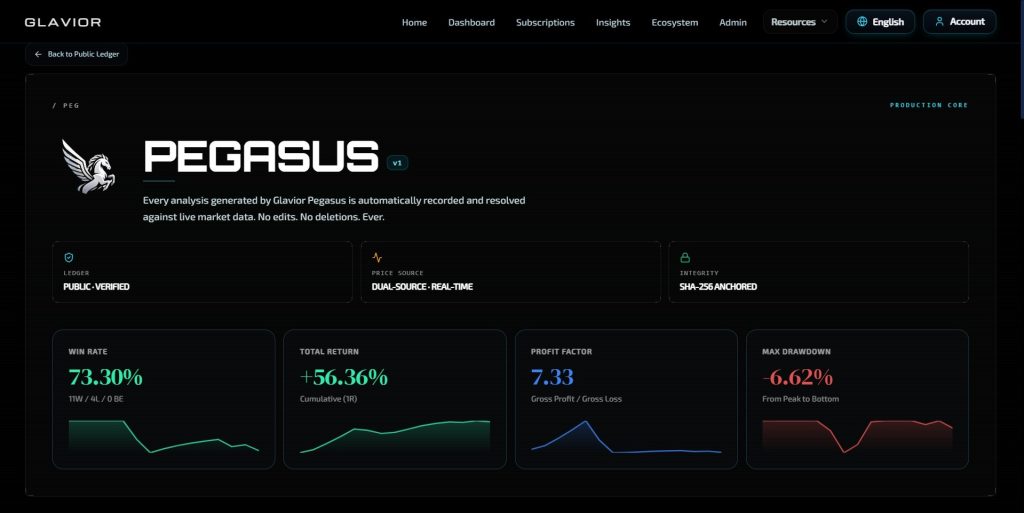
At the center of the product is Pegasus, Glavior’s proprietary market-analysis model.
It evaluates market structure, liquidity, order flow, momentum, derivatives activity, volatility, news, on-chain data, chart formations, and risk before deciding whether an opportunity should become a complete trade plan.
Most opportunities are intended to be rejected rather than shown to users. The platform can then connect through APIs to a user’s own exchange account and execute an approved plan without taking custody of the user’s assets.
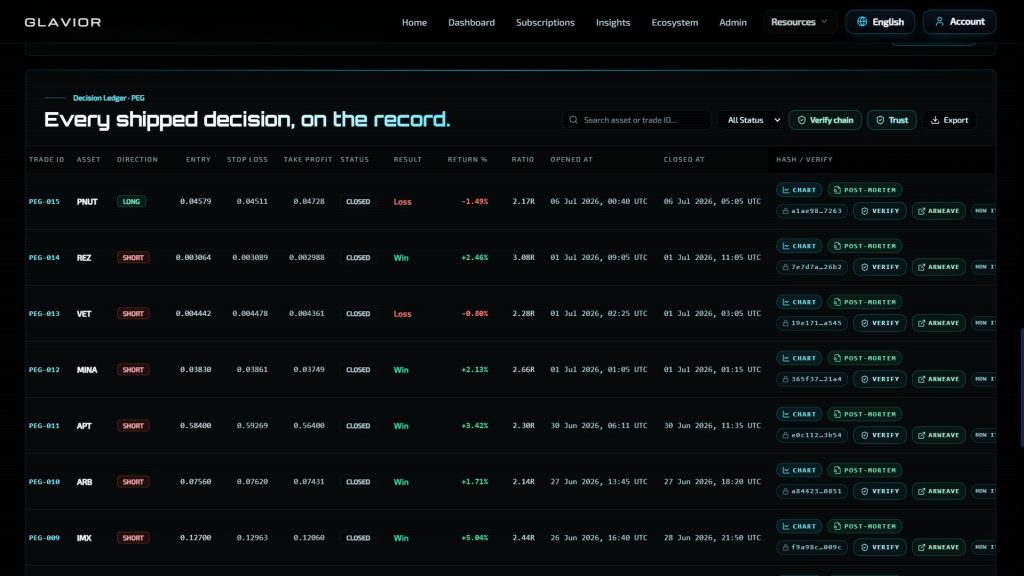
Saluja also built a public, hash-chained performance ledger designed to record official analyses before their outcomes become known.
The records are cryptographically anchored using Bitcoin OpenTimestamps and Arweave so users can inspect the historical track record rather than relying entirely on screenshots or marketing claims.
The official records for Pegasus v1 and Pegasus v2 are available separately for public inspection.
The work covers engineering, product, infrastructure, deployment, operations, and early customer acquisition.
Saluja remains Glavior’s sole founder and owns 100 percent of the company.
What AI Changed
Glavior is part of a wider shift in software development.
Artificial intelligence tools are allowing individuals to work across disciplines that previously required larger teams, higher budgets, and more formal technical training.
A founder can now use AI to study unfamiliar systems, generate and review code, debug infrastructure, compare architectural options, create interfaces, analyze data, and iterate much faster than was previously possible.
For someone with limited capital and no established technology network, that changes what is possible But Saluja’s experience also demonstrates what AI does not remove.
It does not decide which problem deserves years of attention. It does not automatically distinguish a credible financial product from an impressive-looking prototype. It does not take responsibility when execution fails, data is incorrect, security controls break, or users are exposed to risk.
The development of Pegasus required repeated experimentation with different market-analysis strategies, evaluation against market data, removal of weak approaches, and refinement of the strongest decision logic.

Building the execution layer required attention to authentication, exchange connectivity, order handling, failure conditions, reconciliation, and risk reduction.
Building the public ledger required decisions about what should count as an official production analysis and how the record could remain inspectable after outcomes were known.
AI accelerated parts of that work. It did not eliminate the work itself.
“AI helped me build across areas that would normally need different people,” Saluja said. “But it still took months of testing, rebuilding, and finding out that something which looked correct was not reliable enough for production.”
Choosing the Company Full-Time
After completing Class 10, Saluja decided not to continue along the conventional school path. He chose to work on Glavior full-time.
The decision was not supported by an existing venture-capital round, a large user base, or a team waiting for him.
The company remained self-funded, with no outside investment and no financial support from family or friends. For Saluja, the decision was based on the stage of the product and the amount of focused work he believed it required.
The choice carries obvious risk. Glavior still has to prove commercial demand.
Its controlled beta is designed to measure whether users complete onboarding, return to the platform, request repeated analysis, connect exchange accounts, execute trades, refer others, and eventually pay for the product.
The company is not yet claiming product-market fit, recurring revenue, or a repeatable acquisition engine. That’s an important distinction.
Building a technically complete platform is not the same as building a sustainable company.
Saluja’s next challenge is distribution. He is currently looking for investors, early users, creators, and distribution partners who can help move Glavior from technical validation into broader commercial use.
Qualified participants can apply for Glavior Beta access.
Selected beta users are expected to receive access to the platform in exchange for structured feedback and real usage data.
Building in Public, Including the Failures
One of Glavior’s most unusual elements reflects Saluja’s experience with unverifiable trading claims. Official Pegasus analyses are intended to be published before their outcomes and preserved afterward, including losing positions.
In its first public production run following the ledger’s June 23 launch, Pegasus v1 recorded 15 official signals. Eleven were classified as wins and four as losses.
The run recorded:
- A 73.3 percent win rate
- A 7.33 profit factor
- A 2.57-to-1 average risk-to-reward ratio
- A 56.36 percent cumulative return using Glavior’s standardized 1R evaluation basis
- A 6.62 percent maximum drawdown
The full initial record can be reviewed through the Pegasus v1 Public Ledger.
The dataset is limited and does not establish long-term performance. Its greater relevance may be the decision to make the results inspectable before the company has a large audience.
Pegasus v2 is now live with changes to its inference, calibration, validation, decision, and execution pipeline. Its developing public record can be followed through the Pegasus v2 Public Ledger.
Most early-stage founders prefer to reveal only what is working.
Saluja is attempting to make failures part of the permanent product record.
A Different Kind of Founder Story
It would be easy to reduce Saluja’s story to his age.
A sixteen-year-old founder who left school after Class 10 and built a global product alone creates an attention-grabbing headline. But age is not the most important part of the story.
The more significant change is that the cost of attempting something ambitious has fallen dramatically.
A teenager in Hazaribagh, India, without a traditional engineering team or outside capital can now build and deploy software involving artificial intelligence, global localization, financial-market data, cryptographic verification, database infrastructure, and exchange execution.
That does not mean everyone with access to AI can build a valuable company. The barriers have moved.
Access to technical implementation is becoming easier. Choosing the right problem, understanding it deeply, testing honestly, earning trust, and finding distribution remain difficult.
Saluja’s own path reflects both sides of that shift. Technology made it possible for him to attempt Glavior.
His experience losing money gave him the problem. Years of operating online businesses gave him commercial instincts. Repeated failure during development forced him to improve the product.
Glavior’s future is not guaranteed. It will be determined by whether the platform creates sustained value for real users, not by the founder’s age or the novelty of building alone.
But the company represents something larger than one financial product.
A new generation of founders is gaining the ability to build before receiving permission, credentials, capital, or a conventional team. The tools are becoming available to almost everyone.
The willingness to take responsibility for what those tools produce remains rare.
Readers can explore Glavior, inspect its public performance ledger, or apply to join its controlled beta.
About Tanishq Saluja
Tanishq Saluja is the 16-year-old founder and CEO of Glavior.
He began earning online at nine, started TSS Market at twelve, began trading financial markets at thirteen, and started building Glavior after losing approximately $40,000 through trading.
He has built and self-funded the platform without a co-founder, employees, or outside investment.