


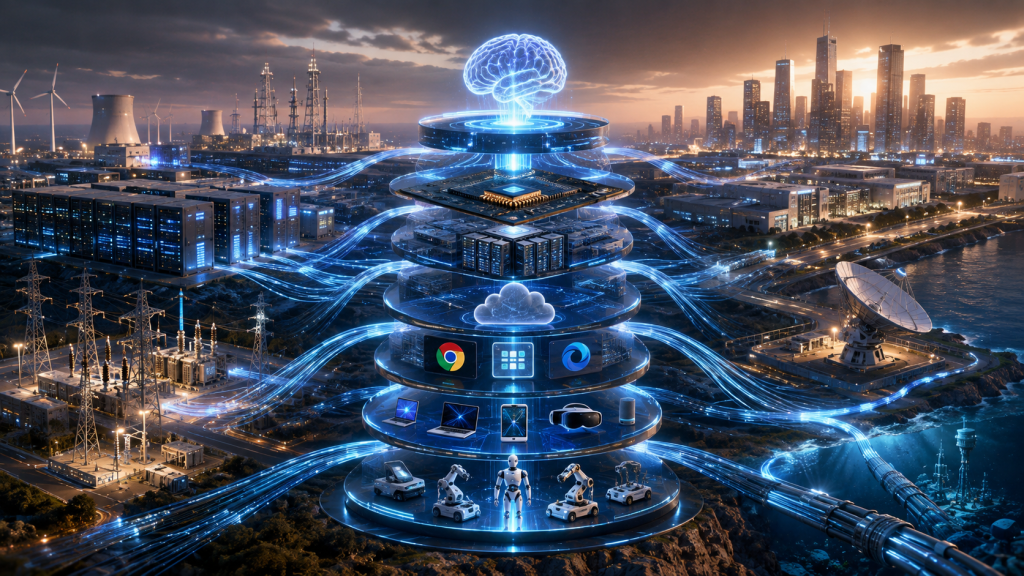
Not long ago, the artificial intelligence race appeared refreshingly simple. Build the smartest model, release the best chatbot, and hope everyone used it. AI Companies competed over benchmark scores, reasoning ability, and who could generate the most convincing essay, image, or piece of code. Every few months a new model claimed the top spot, and the leaderboard shuffled once again. It made for exciting headlines, but it increasingly looks like those headlines were describing only the opening chapter.
The real competition has changed.
Today’s largest AI companies are no longer racing to build better models alone. They are quietly assembling entire ecosystems that stretch far beyond software. They are designing custom chips, constructing enormous data centers, investing in power generation, developing browsers, launching hardware, building AI agents, and integrating payment systems. Increasingly, they want to control every layer of the AI experience, from the silicon performing the calculations to the interface sitting in front of the user. The company that owns the entire stack may ultimately enjoy a much greater advantage than the company with the smartest chatbot.
Models Are Becoming Commodities
Only a few years ago, possessing the most capable AI model was enough to command attention. Today, however, the gap between leading models has narrowed considerably. OpenAI, Anthropic, Google, Meta, xAI, and several others now produce systems capable of writing, coding, reasoning, and generating content at remarkably high levels. Each new release still attracts headlines, but competitive advantages measured in benchmark points rarely remain exclusive for long.
That creates a challenge.
If every major company eventually builds similarly capable models, intelligence alone becomes less valuable as a competitive moat. Technology companies understand this pattern well because they have seen it before. Search engines became commodities. Cloud infrastructure became commodities. Smartphones matured into highly competitive markets where ecosystems mattered more than raw specifications. Artificial intelligence appears to be following a similar path.
When products become comparable, the surrounding ecosystem often determines who wins.
Owning The Infrastructure
Artificial intelligence depends on an astonishing amount of infrastructure.
Modern models require advanced semiconductors, hyperscale data centers, massive networking capacity, cooling systems, and enough electricity to power entire communities. Every AI response begins with billions of dollars’ worth of hardware quietly performing calculations somewhere inside an enormous facility that most users will never see.
That explains why technology companies are investing so heavily in infrastructure. Nvidia dominates AI accelerators. Microsoft and Google continue expanding cloud capacity. Meta is building enormous AI campuses. OpenAI has announced ambitious data center projects. Across the industry, companies are signing long-term energy agreements, developing custom silicon, and securing access to computing resources that may determine future competitiveness.
The AI race increasingly resembles a construction project.
Software still matters, but so do concrete, steel, transformers, fiber cables, and power plants. Silicon Valley has discovered that the cloud, despite its poetic name, remains remarkably attached to the ground.
Hardware Is Back
Another notable shift is the return of hardware.
For years, software companies largely relied on smartphones and personal computers built by others. Artificial intelligence is changing that relationship. OpenAI is developing consumer hardware alongside legendary Apple designer Jony Ive. Meta continues investing in smart glasses. Google is embedding Gemini across its Pixel devices. Apple is integrating Apple Intelligence deeply into its own hardware ecosystem. Amazon is reinventing Alexa around generative AI while continuing to expand Echo devices.
None of these companies wants AI to exist solely as an app downloaded from someone else’s platform.
They want to own the experience from beginning to end. Hardware provides direct access to users, tighter software integration, and valuable contextual information that standalone applications simply cannot replicate. If artificial intelligence becomes the primary way people interact with technology, controlling the device itself becomes strategically important once again.
The Ecosystem Becomes The Product
Perhaps the biggest shift is that AI is no longer just a feature.
Increasingly, it is becoming the foundation that connects everything else. Browsers evolve into AI assistants. Operating systems become conversational interfaces. Productivity software, search engines, communication platforms, cloud services, payments, shopping, and even robotics begin sharing the same underlying intelligence.
That creates powerful network effects. An AI assistant connected to your email, calendar, documents, browser, financial accounts, and smart devices becomes significantly more useful than one limited to answering isolated questions. Every additional service strengthens the ecosystem while making it more difficult for users to leave.
Technology companies understand this dynamic exceptionally well. Apple built one of the world’s most valuable businesses by creating an ecosystem rather than a collection of individual products. Google did the same through search, Android, Chrome, Gmail, and Maps. Microsoft connected Windows, Office, Azure, and enterprise software. AI companies now appear to be following a remarkably similar strategy.
The model may attract users.
The ecosystem keeps them.
Looking Ahead
Artificial intelligence will undoubtedly continue improving, but smarter models alone are unlikely to determine the industry’s long-term winners. The companies best positioned for the next decade may be those that control the largest portion of the AI stack, from chips and data centers to operating systems, hardware, and the everyday services people rely on.
That helps explain why today’s biggest AI announcements increasingly involve infrastructure rather than algorithms. Data centers, semiconductor factories, custom chips, energy projects, browsers, and devices may sound less exciting than the latest chatbot release, but they represent something far more significant. They are the foundation upon which tomorrow’s AI economy will be built.
The AI race is no longer just about creating intelligence.
It is about owning everything that intelligence touches.