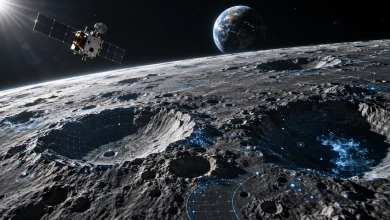
Elon Musk believes the rapid growth of artificial intelligence could push Earth’s power infrastructure to its limits by 2029, making orbital computing a potential solution for scaling AI. Musk’s prediction comes as AI companies race to build increasingly powerful data centers that require enormous amounts of electricity, advanced cooling systems and large amounts of computing hardware. Recent reports say Musk argued that orbital compute could become the only practical way to continue expanding AI infrastructure if terrestrial power generation and permitting cannot keep pace with demand.
The idea involves placing AI data centers and high performance computing hardware in satellites orbiting Earth. Instead of relying entirely on terrestrial power grids, orbital data centers could use abundant solar energy and radiative cooling while transmitting processed data back to Earth through high speed satellite networks. SpaceX has already positioned orbital AI compute as a major part of its long term strategy, saying its Starmind system will use satellites with localized AI computing and laser links to the Starlink network.
Why Musk Thinks AI Could Move Into Orbit
The biggest argument behind orbital AI computing is energy. Training and operating increasingly capable AI models requires massive amounts of electricity, while building new terrestrial data centers often involves lengthy grid connection processes, power-generation projects, land approvals and environmental permits. Musk’s argument is that these constraints could become severe enough by 2029 to force the AI industry to look beyond Earth for additional computing capacity.
Space offers a fundamentally different infrastructure environment. Solar panels in suitable orbits can receive sunlight for much of the time, while spacecraft can reject heat through radiators instead of relying on conventional data center cooling systems. SpaceX says its proposed AI satellites can take advantage of readily available solar power and space-based cooling, with data moving through high bandwidth laser connections to Starlink. Its AI1 concept lists a 150 kilowatt peak compute payload, a 120 kilowatt average compute level and a 70 meter wingspan.
SpaceX’s own corporate filings show that the company is taking the concept seriously rather than treating orbital computing as a distant science-fiction idea. The company says it expects to begin deploying orbital AI compute satellites as early as 2028 and believes meaningful amounts of computing capacity could reach orbit in 2029. However, SpaceX also acknowledges that scaling production and launches remains a major challenge.
Will Orbital Compute Really Happen by 2029?
The answer is possibly, but probably not at the scale Musk’s prediction suggests. There is already a credible development path toward putting AI computing hardware in orbit before 2029. SpaceX has outlined specific satellite designs, power requirements, networking technology and deployment targets, while its filings describe orbital AI computing as a potential way to bypass terrestrial energy constraints.
The harder question is whether orbital computing can become a major source of global AI capacity by 2029. Building a demonstration satellite is very different from deploying enough computing hardware to compete with massive terrestrial AI data centers. SpaceX says that deploying around 10 gigawatts of computing power annually would require a major increase in manufacturing and launch capacity, while its longe -term vision could require thousands of launches each year.
Launch economics will therefore play a decisive role. Space based AI computing only becomes compelling if rockets can repeatedly deliver large quantities of processors, solar arrays, radiators and other equipment into orbit at competitive costs. SpaceX’s reusable launch technology gives it a major potential advantage, but the company still needs to prove that it can manufacture, launch, operate and eventually replace enormous numbers of AI satellites economically.
There are also technical challenges. AI processors generate significant heat, radiation can damage electronics, hardware failures become difficult to repair once satellites reach orbit, and networking thousands of computing platforms requires sophisticated coordination. SpaceX acknowledges that significant work remains, even as it argues that its existing satellite manufacturing, Starlink n
etworking and launch capabilities provide a foundation for orbital AI infrastructure.Environmental concerns could also complicate the vision. Moving AI data centers into space could reduce some pressure on terrestrial electricity and water resources, but launching huge numbers of satellites would create additional emissions and increase the amount of material entering and leaving Earth’s atmosphere. Scientists have warned that a massive expansion of AI satellite constellations could create atmospheric and astronomical consequences that require further study.
2029 Could Be the Beginning, Not the Tipping Point
A more realistic scenario is that 2029 becomes an important demonstration year for orbital AI rather than the moment when data centers suddenly move from Earth into space. SpaceX could have operational AI compute satellites by then, potentially processing workloads in orbit and returning results through Starlink. Company executives have even discussed the possibility of AI inference occurring on orbital satellites and reaching users through Starlink around that timeframe.
If that happens, it would represent a significant milestone for the AI infrastructure industry. It would prove that computing hardware can operate as part of a distributed orbital network and that solar power, thermal management, satellite networking and reusable launch systems can work together for commercial AI workloads.
However, saying orbital computing will be the only way to scale AI by 2029 remains a prediction rather than an established fact. Terrestrial data centers will continue expanding through new power plants, renewable energy projects, nuclear generation, improved chips, more efficient AI models and better data-center designs. Orbital computing could become another major layer of the AI infrastructure stack rather than an immediate replacement for Earth based computing.
The strongest evidence suggests that Musk’s 2029 prediction should be viewed as a warning about the energy requirements of AI as much as a forecast about space. If AI computing demand continues growing exponentially while electricity generation and grid infrastructure fail to expand at the same pace, companies will have to explore increasingly unconventional solutions. Orbital computing is one of the most ambitious options, and SpaceX has already begun laying out a technical roadmap for it.
So, will orbital compute happen by 2029? A limited operational version looks increasingly plausible. Whether it becomes the only viable way to scale AI by 2029 is much less certain. The next three years will determine whether orbital AI moves from an ambitious Musk vision into a commercially meaningful part of the global computing infrastructure.