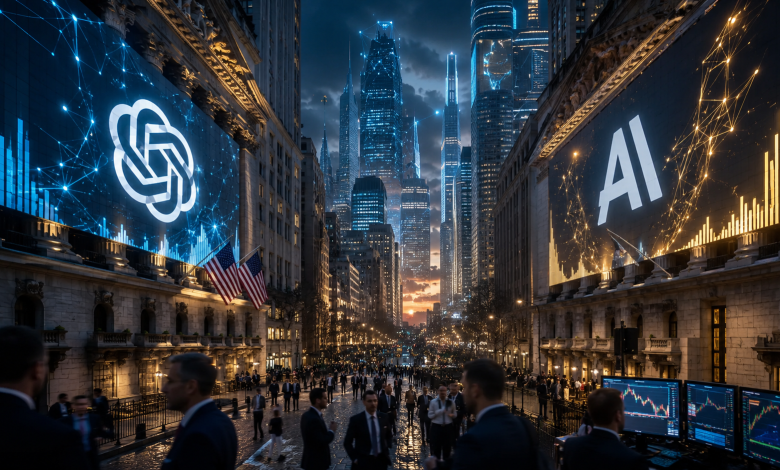
The artificial intelligence race is moving from Silicon Valley to Wall Street.
OpenAI and Anthropic are advancing toward potential initial public offerings that could rank among the largest technology listings in history, setting up a new contest between the companies that extends well beyond whose artificial intelligence models are more capable.
Anthropic currently appears closer to the starting line. The company confidentially filed IPO paperwork with the U.S. Securities and Exchange Commission in June and is preparing to publicly unveil its prospectus shortly after Labor Day, according to reports cited by Reuters. A listing could follow in late September or early October.
OpenAI followed Anthropic with its own confidential filing in June. However, the ChatGPT maker has been more cautious about committing to a timetable, saying the filing gives it flexibility and that remaining private could make some of its near-term plans easier to execute.
That leaves Anthropic with a potentially important advantage. It could become the first of the two frontier AI laboratories to face the scrutiny, and opportunity, of public markets.
AI’s rivalry reaches Wall Street
The financial numbers behind the race are extraordinary.
Anthropic’s annualized revenue run rate reportedly surpassed $65 billion at the end of July after the company generated more than $11.5 billion in preliminary second-quarter revenue. Axios reported that the figure represented more than 14 times its revenue from the same quarter a year earlier.
OpenAI, meanwhile, recently reached a reported revenue run rate of $40 billion. Comparisons between the companies require caution because they may calculate revenue differently, but the figures illustrate how quickly frontier AI has developed into a major commercial market.
Anthropic has built much of its momentum around enterprise customers, positioning Claude as an AI system for businesses and developers. That strategy has produced rapid growth, but it could also become a vulnerability if companies begin scrutinizing the escalating cost of AI services more aggressively.
OpenAI has a different advantage. ChatGPT has given the company enormous consumer recognition, while its expanding enterprise business means it increasingly competes with Anthropic for the same corporate customers.
The companies are also approaching the public markets while continuing to spend heavily on the infrastructure required to develop and operate increasingly powerful models. Access to public capital could provide another source of funding for computing capacity, custom silicon and the enormous data center networks underpinning frontier AI.
Going public, however, would change the relationship between AI laboratories and their investors.
Public shareholders will expect greater financial transparency and eventually clearer evidence that enormous infrastructure expenditures can translate into durable profits. Revenue growth, inference costs, customer concentration, capital expenditure and margins could become nearly as important to investors as benchmark performance.
Safety becomes an investor question
The timing is particularly complicated because both companies are simultaneously confronting the risks created by increasingly capable AI systems.
OpenAI said this week that its upcoming Astra model has reached a capability threshold requiring stronger safeguards, particularly around cybersecurity. The company said Astra can identify vulnerabilities and perform sophisticated tasks with greater autonomy, leading OpenAI to restrict some capabilities and strengthen protections ahead of release.
Anthropic has been adjusting its own balance between capability and restrictions. Its latest model releases include changes to safety interventions, pricing and enterprise privacy protections, reflecting pressure to make advanced AI useful enough for commercial customers without abandoning safeguards around potentially dangerous applications.
That tension could become a defining issue for both IPOs.
Private AI companies can prioritize long-term research objectives while relying on venture investors willing to tolerate enormous spending and uncertain profitability. Public companies operate under a different rhythm, with quarterly results, analyst expectations and shareholder pressure creating constant incentives for growth.
Anthropic faces an additional governance question because it operates as a public benefit corporation, a structure requiring it to balance shareholder interests with its stated mission around the responsible development of advanced AI.
Investors will ultimately have to decide how much that distinction matters.
For both companies, the IPO race therefore represents something larger than a fundraising exercise. It is an early test of whether frontier AI can transition from one of the most aggressively financed private technology experiments in history into a sustainable public-market industry.
The competition between OpenAI and Anthropic began with models. It expanded into enterprise customers, developers, computing infrastructure and talent.
Now Wall Street is becoming the next battleground.