


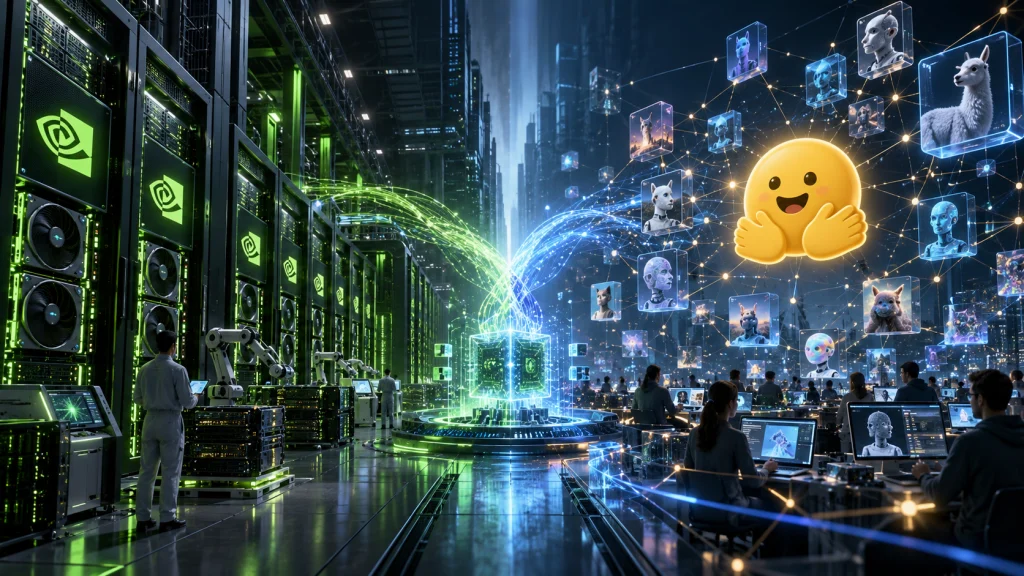
Nvidia has agreed to acquire Hugging Face for $12.93 billion, giving the world’s dominant AI chipmaker control of one of the most important platforms in the open artificial intelligence ecosystem.
The deal, announced on September 3, represents one of Nvidia’s largest acquisitions and marks a significant expansion beyond the processors and computing systems that have powered the generative AI boom. It also gives Nvidia a much deeper position inside the developer ecosystem where AI models are shared, tested, customized and deployed.
Under the agreement, Nvidia will pay about $11.9 billion to Hugging Face shareholders and provide up to $1 billion in stock-based incentives designed to retain employees, according to Reuters. Hugging Face was valued at $4.5 billion in a 2023 funding round, meaning Nvidia is paying a substantial premium for a company that has become a central piece of AI infrastructure.
Nvidia Moves Deeper Into the AI Ecosystem
Founded in 2016 by Clément Delangue, Julien Chaumond and Thomas Wolf, Hugging Face has evolved from an early chatbot project into a major platform for open AI development.
The company operates a hub where developers and researchers can publish, download and collaborate on machine learning models, datasets and applications. Nvidia says the platform now serves more than 18 million developers, researchers and creators, hosts more than 3 million models and is used by more than 200,000 companies.
That reach makes the acquisition strategically important for Nvidia. The company already dominates the hardware used to train and run many advanced AI systems, but Hugging Face provides access to another critical layer of the industry, the developers deciding which models, frameworks and infrastructure to use.
The purchase could therefore strengthen Nvidia’s position as an end-to-end AI infrastructure provider rather than simply a supplier of GPUs.
It also comes as major Nvidia customers develop more of their own chips and infrastructure. Reuters reported that the Hugging Face acquisition could help Nvidia diversify its position as companies including Meta, Microsoft and OpenAI pursue custom AI silicon.
Hugging Face Will Remain Open
One of the biggest questions surrounding the acquisition is whether Hugging Face can maintain its hardware-neutral and open approach under Nvidia ownership.
Nvidia CEO Jensen Huang said the company intends to preserve that model.
According to Nvidia, developers will remain free to choose their preferred models, frameworks, cloud providers, inference services and computing platforms. Nvidia hardware will not be required to build or deploy models through Hugging Face, and the platform is expected to continue supporting multiple clouds and accelerator architectures.
That commitment will be closely watched. Hugging Face has built much of its influence by serving as a relatively neutral meeting point for the AI industry, including developers working with technology from Nvidia’s competitors.
Analysts cited by Reuters have raised concerns that Nvidia ownership could eventually result in preferential treatment for its own hardware, even if the company maintains Hugging Face’s interoperability in the near term.
The deal also represents a major bet on open-weight AI. As proprietary systems compete with increasingly capable open models, Nvidia has a strong incentive to ensure that developers can continue accessing a broad range of models that ultimately require computing infrastructure to train and operate.
By acquiring Hugging Face, Nvidia is positioning itself closer to the center of that ecosystem.
The strategic logic goes beyond immediate revenue. Nvidia already supplies much of the computing power behind the AI industry. Hugging Face gives it influence over one of the places where that computing power is put to work.
If Nvidia can preserve the openness that made Hugging Face successful while using its resources to expand the platform, the $12.93 billion acquisition could become one of the most consequential infrastructure deals of the AI era.