


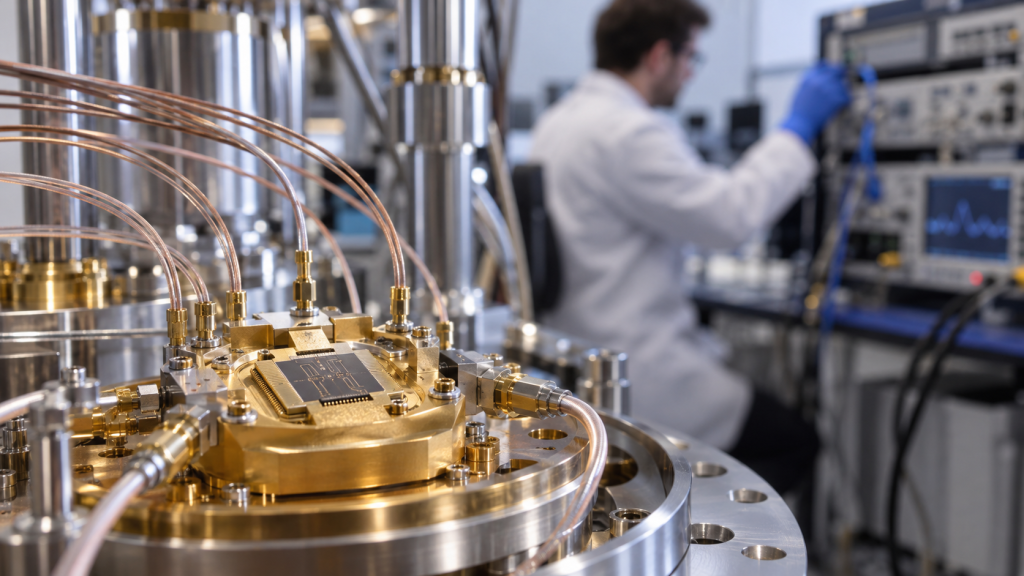
A new silicon qubit control technique could make it easier to scale quantum processors without sacrificing as much accuracy when several qubits operate at once. Researchers at Japan’s RIKEN Center for Emergent Matter Science and collaborators demonstrated parallel control of five silicon spin qubits through a shared microwave line, maintaining roughly 99.9% gate fidelity when all five were active. The result addresses a practical engineering challenge, but it is not a demonstration of a large, fault-tolerant quantum computer.
How silicon qubit control improved parallel operation
Silicon spin qubits are attractive partly because they may be manufactured using methods related to conventional semiconductor production. However, control signals aimed at one qubit can unintentionally shift the phase of nearby qubits, reducing accuracy when several operations happen simultaneously. The RIKEN team traced a major source of this error to the AC Stark shift and developed a calibration method to compensate for it.
The approach uses measurements between pairs of qubits to estimate and correct unwanted phase shifts. This is intended to scale more efficiently than separately calibrating every possible combination of qubits. In the team’s five-qubit experiment, single-qubit gate fidelity exceeded 99.99% when each qubit operated individually, and fidelity remained above 99.99% when up to three qubits ran at once.
Why silicon qubit control matters for larger processors
The silicon qubit control result matters because a useful quantum processor will need many qubits to perform operations concurrently while keeping errors low. Giving each qubit an entirely independent control path can make a system harder to wire, calibrate and operate as it grows. Shared control lines may reduce that complexity, provided the system can maintain reliable performance.
When all five qubits were controlled simultaneously, the reported fidelity was approximately 99.9%, lower than the result for three qubits but still a notable improvement over the uncorrected behavior. The remaining degradation was linked to drive-induced decoherence associated with the higher microwave power needed for parallel operation. The researchers said further device-design improvements may help reduce that limitation.
What silicon qubit control does not prove yet
The experiment is a step toward larger processors, not proof that practical fault-tolerant computing is already available. The team tested five qubits in a controlled research setup; real systems will need to preserve accuracy across more qubits, longer computations, device variation and error-correction overhead. A gate-fidelity figure alone does not establish that a processor can outperform classical machines on useful tasks.
RIKEN’s research announcement describes the work as progress toward larger silicon-based quantum processors, and the study appeared in Nature Physics. The evidence supports a specific conclusion: pairwise calibration can mitigate an important source of simultaneous-control error. It does not eliminate decoherence or other engineering challenges that arise as the number of qubits increases.
Next milestones for silicon qubit control
The next questions are whether the calibration method remains effective in larger arrays, how it behaves under changing operating conditions, and whether device design can reduce the residual loss of fidelity. Independent replication and tests on more complex operations will also matter before the approach can be judged for practical systems.
For readers tracking the wider computing ecosystem, the result sits alongside advances in conventional chip design and manufacturing rather than replacing them. Kernel.news has covered the scale of Nvidia’s chip business, a reminder that different computing architectures face different performance and scaling constraints. The immediate takeaway from this silicon qubit control work is narrower but useful: shared microwave control appears more feasible when a key source of phase error is calibrated out.
Sources: RIKEN, October 16, 2026; ScienceDaily, October 25, 2026; Nature Physics paper, published October 15, 2026.