


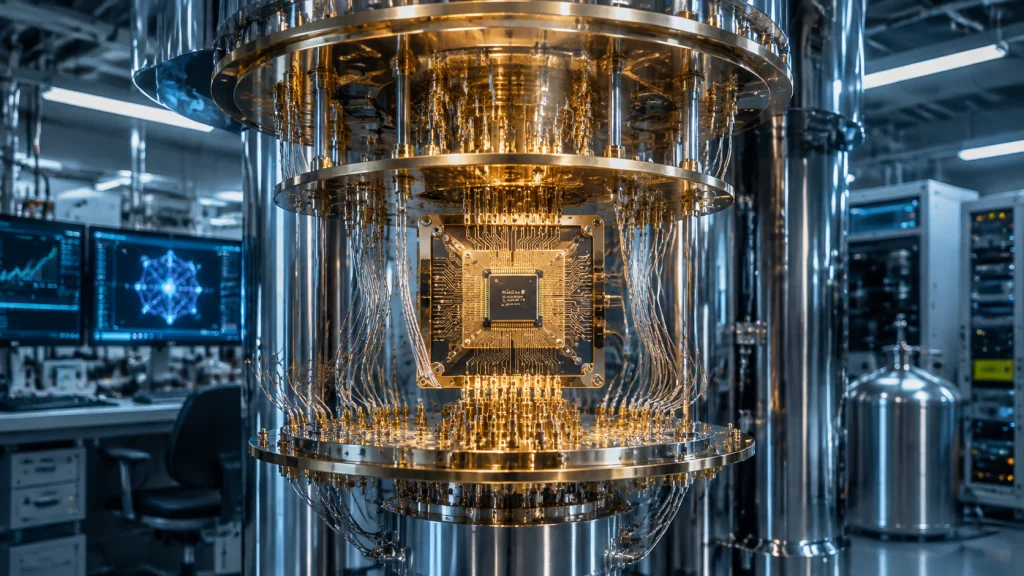
IBM Nighthawk r3 is the company’s planned next-generation quantum processor, designed to execute 10,000 quantum operations across 520 programmable qubits. IBM announced the design on November 11 and said it plans to connect two r3 processors into a system with 1,040 qubits in 2027. The figures describe a product roadmap, not a processor that customers can use today.
What IBM Nighthawk r3 is designed to deliver
IBM says Nighthawk r3 will contain 520 programmable qubits and 2,034 total physical qubits. It is designed to support circuits with up to 10,000 quantum operations while retaining the square-lattice connectivity and fast operation approach used by the current Nighthawk generation. The r3 design also introduces 10 chip-to-chip interconnects, which IBM calls l-couplers, intended to connect processors into larger systems.
The distinction between programmable and physical qubits is important. The 520 figure describes the qubits available for programming quantum circuits, while the 2,034 figure includes the wider physical hardware used to implement the processor. The 10,000 figure refers to the target number of quantum operations, not to a qubit count or a measurement of general-purpose computing speed.
IBM says it plans to link two Nighthawk r3 processors in 2027 to create a 1,040-qubit system. That is a future milestone, and the company has not announced a customer availability date, price or complete performance specification for the r3 processor. Its November 11 announcement sets out the company’s current roadmap.
How IBM Nighthawk r3 builds on the current r2 processor
The announcement also describes the Nighthawk r2 processor, which IBM says is available today with 120 programmable qubits, accurate computations involving more than 7,500 quantum operations and throughput of up to 100,000 samples per second. IBM says clients and partners including E.ON, Algorithmiq and Q-CTRL have run more than 34 billion circuits on r2 and reported performance improvements of up to 19 times compared with earlier IBM quantum processors.
Those performance figures are workload-specific and come from IBM and its partners. IBM cites a 15-times speedup for E.ON’s quantum machine-learning work on energy-grid optimization and a 12-times improvement in an experiment with Oak Ridge National Laboratory involving magnetic materials. These are useful examples of progress on particular research tasks, but they should not be interpreted as proof that a quantum computer now outperforms classical computers across broad categories of commercial workloads.
Independent coverage by Ars Technica notes that IBM’s revised roadmap changes how it expects to reach a system above 1,000 qubits. The engineering challenge is not simply adding more qubits: processors also need reliable operations, effective connections between chips and ways to manage errors as circuits become larger.
Why the IBM Nighthawk r3 interconnects matter
Quantum processors are difficult to scale because qubits are sensitive to noise and errors. A larger chip can offer more programmable qubits, but it must also preserve enough connectivity and operational quality for useful circuits. IBM’s 10 l-couplers are intended to support communication between separate processors, allowing a future system to combine multiple chips rather than relying only on one increasingly large device.
IBM says it has already demonstrated earlier versions of this modular approach. It reports that two Nighthawk r1 processors were connected using four l-couplers, achieving 99.3 percent quantum-state transfer fidelity. The company has described 99.9 percent as its target. That earlier demonstration is a technical step toward the r3 plan, but it does not establish that the planned 1,040-qubit system has already been built or that its final performance is known.
The company is also expanding its software environment to bring quantum workloads together with classical high-performance computing. This hybrid approach matters because practical quantum applications are likely to rely on classical systems for workflow orchestration, error mitigation, data processing and analysis alongside quantum circuits.
What IBM Nighthawk r3 does not prove yet
The announcement is a roadmap update, not a claim that a fault-tolerant, general-purpose quantum computer is commercially available. IBM has not published a full r3 error-rate profile, independent benchmark results for the planned chip, pricing or a confirmed customer delivery schedule. The 2027 two-processor system remains a stated plan.
Readers should therefore separate three measures: qubit count, the number of operations a circuit can execute accurately, and the speed at which results can be sampled. Each affects the kinds of workloads a quantum system may handle, and none alone establishes a practical advantage over classical computing. The results reported for r2 provide evidence of progress on selected applications; they do not settle the broader question of when quantum computers will deliver repeatable commercial value.
Kernel.news has previously examined the physics behind the field in its report on quantum magnet behavior and its implications for quantum research. The Nighthawk r3 announcement adds a hardware roadmap to that wider research story, with the next test being whether IBM can deliver the planned scale while maintaining the accuracy needed for meaningful computations.
Sources: IBM, November 11, 2026; Ars Technica, November 11, 2026; Constellation Research, November 11, 2026.