Blue Origin Suffers Major New Glenn Loss After Test Stand Explosion

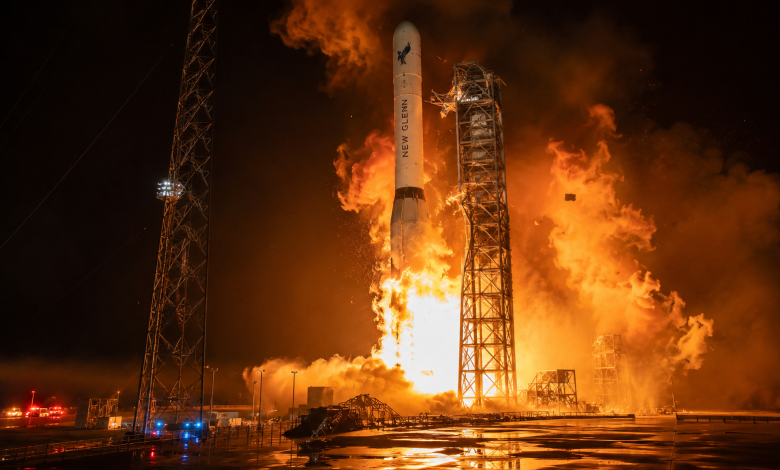
Blue Origin’s New Glenn rocket was destroyed Thursday night after a catastrophic explosion during a routine hot-fire test at Cape Canaveral, dealing a significant setback to Jeff Bezos’ space company and raising questions about upcoming commercial and government missions.
The incident occurred at approximately 9 p.m. EDT on May 28 at Launch Complex 36, where engineers were conducting what was expected to be a final static-fire test before the vehicle’s planned June launch.
Video footage captured the rocket’s seven BE-4 engines igniting briefly before flames rapidly spread around the base of the vehicle. Seconds later, the 322-foot-tall rocket erupted into a massive fireball, sending debris, smoke, and flames high above the launch site. Early reports indicate that at least one lightning protection tower was damaged in the blast.
Blue Origin confirmed the event shortly after it occurred.
“We experienced an anomaly during today’s hotfire test. All personnel have been accounted for. We will provide updates as we learn more,” the company said in a statement posted on X.
Founder Jeff Bezos later addressed the incident, emphasizing that no injuries had been reported and that an investigation was already underway.
“All personnel are accounted for and safe. It’s too early to know the root cause, but we’re already working to find it,” Bezos wrote. “Very rough day, but we’ll rebuild whatever needs rebuilding and get back to flying.”
The Federal Aviation Administration said the test was not part of a licensed launch operation and confirmed there was no impact on commercial air traffic. The payload intended for the mission was not aboard the vehicle at the time of the explosion.
Blow to New Glenn Program
The loss represents one of the most serious setbacks in Blue Origin’s history.
New Glenn serves as the company’s flagship orbital launch vehicle and is central to its ambitions in the commercial launch market. Designed to compete with SpaceX’s Falcon Heavy and future Starship missions, the heavy-lift rocket is expected to carry commercial satellites, national security payloads, and lunar infrastructure into orbit.
Beyond the destruction of the flight hardware itself, industry observers expect significant delays as Blue Origin assesses damage to Launch Complex 36 and begins repairs to the launch infrastructure.
The timing is particularly challenging for Amazon’s satellite broadband initiative. The upcoming mission was expected to carry a new batch of Project Leo internet satellites as part of the company’s effort to build a global low-Earth orbit communications network. Any prolonged grounding of New Glenn could force adjustments to deployment schedules and launch planning.
Artemis Implications
The explosion may also have implications for NASA’s long-term lunar ambitions.
Blue Origin has secured a growing role within the Artemis program, including responsibilities related to lunar cargo delivery and components of the company’s Blue Moon lunar lander architecture. While it remains too early to determine the full impact, analysts say extended delays could place additional pressure on mission timelines and increase reliance on alternative launch providers.
NASA officials acknowledged the incident and indicated they will work closely with Blue Origin to assess potential consequences for future missions.
Industry Response
Reaction from across the space sector was swift.
SpaceX CEO Elon Musk offered a brief public response, writing, “Most unfortunate. Rockets are hard.”
The comment reflects a reality familiar to the modern space industry. Major launch systems routinely face technical failures during development and testing, and both SpaceX and Blue Origin have experienced costly setbacks while pursuing increasingly ambitious programs.
For Blue Origin, however, the challenge now shifts from development to recovery. The company must determine the cause of the explosion, restore damaged infrastructure, and demonstrate that New Glenn can return to flight without significant long-term disruption.
As investigators begin their analysis, the incident stands as a reminder of the immense technical and financial risks involved in modern spaceflight.