As AI-powered trading systems become more deeply embedded in global finance and crypto markets, a growing number of analysts are asking an intriguing question: are the machines merely reacting to volatility, or are they quietly pouring fuel on the fire?
For generations, market turmoil was blamed on familiar culprits: fear, greed, panic, irrational decision-making, and occasionally whatever Jim Cramer said the week before.
Now, there may be a new suspect on the list: artificial intelligence.
AI-driven trading systems are becoming increasingly influential across both traditional finance and cryptocurrency markets, prompting researchers to examine whether automated trading is simply responding to market conditions or actively amplifying them.
The Robots Clocked In Long Ago
Algorithmic trading is hardly new. Major financial institutions have relied on automated systems for decades to execute trades faster than any human trader could hope to manage.
Today’s AI-powered models, however, operate on an entirely different scale.
Modern systems can scan enormous datasets, digest breaking news, monitor social media sentiment, identify emerging patterns, and place trades in milliseconds. While human investors are still reading the headline, an AI model may already be halfway through its trading strategy and onto the next opportunity.
That shift means an increasing share of market activity is being influenced by algorithms rather than human instinct.
Whether that makes markets smarter or simply faster remains an open debate.
When Every Machine Thinks It’s a Genius
One of the more fascinating concerns surrounding AI trading is the possibility of machine herd behaviour.
Humans have a long history of following the crowd. Ironically, machines may be developing a digital version of the same habit.
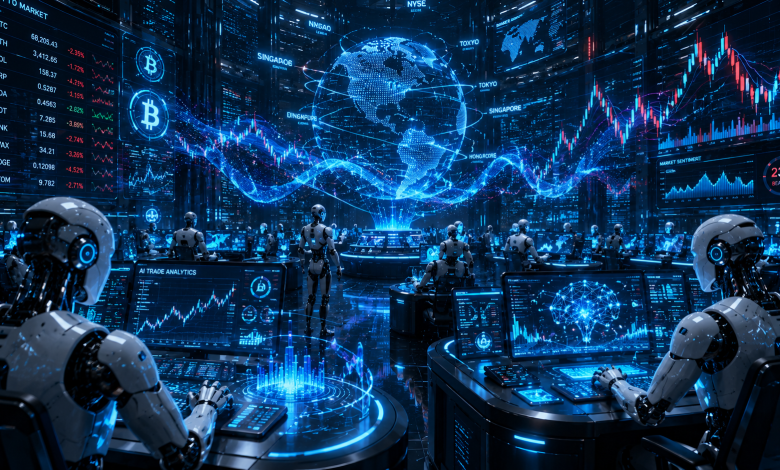
Many AI systems are trained using similar datasets, indicators, and market signals. If thousands of models identify the same trend at roughly the same moment, they may all rush to buy or sell simultaneously. The result can be market moves that feel less like orderly price discovery and more like a synchronized stampede.
In short, Wall Street may be replacing emotional panic with computational panic.
The spreadsheets are different. The chaos can look remarkably familiar.
The Speed Multiplier
Volatility has always been part of investing. What has changed is the pace.
When economic data disappoints, geopolitical tensions escalate, or unexpected news breaks, AI systems can react almost instantly. One algorithm sells. Another notices. A third responds to the second. Before long, a relatively modest move can snowball into something much larger as automated systems continuously react to one another.
Researchers often describe this phenomenon as a feedback loop, where market movements reinforce themselves through repeated automated reactions.
Cryptocurrency markets may be particularly susceptible. They never close, sentiment travels at internet speed, and traders often treat sleep as an optional feature.
AI’s Curious Double Life
Perhaps the most interesting twist is that AI now plays two roles in modern markets.
First, it has become one of the world’s most powerful investment themes. Billions of dollars have flowed into companies building AI infrastructure, software, semiconductors, and data centres.
Second, AI is increasingly responsible for trading many of those same investments.
The result is a slightly surreal dynamic.
AI is attracting capital while simultaneously helping decide where that capital goes.
At times, it can feel as though the machines are trading the AI boom while the AI boom is funding the machines. If that sounds like science fiction, markets have always had a talent for making strange ideas sound perfectly reasonable.
Is AI Behind the Bear Market?
The short answer is no.
Bear markets existed long before artificial intelligence arrived on trading desks. Economic growth, interest rates, monetary policy, geopolitical events, liquidity conditions, and investor sentiment remain the primary drivers of market cycles.
That said, dismissing AI entirely would be a mistake.
The growing influence of automated trading raises legitimate questions about whether algorithms are accelerating reactions to news, increasing volatility, and contributing to sharper price swings during periods of uncertainty.
Humans are still making many of the decisions that shape markets.
The difference is that those decisions are increasingly being filtered, interpreted, and executed by machines.
Looking Ahead
As AI technology continues to evolve, financial markets may become more efficient, responsive, and data-driven than ever before.
They may also become faster, more complex, and occasionally more unpredictable.
For now, investors can take comfort in one enduring truth: despite all the advances in artificial intelligence, nobody has successfully built an algorithm that can perfectly time the market.
If someone ever does, chances are they will keep it to themselves rather than selling subscriptions online.
The modern market is no longer just a contest between bulls and bears.
Increasingly, it is becoming a contest between machines, with humans watching from the sidelines and occasionally pretending they still understand what’s going on.