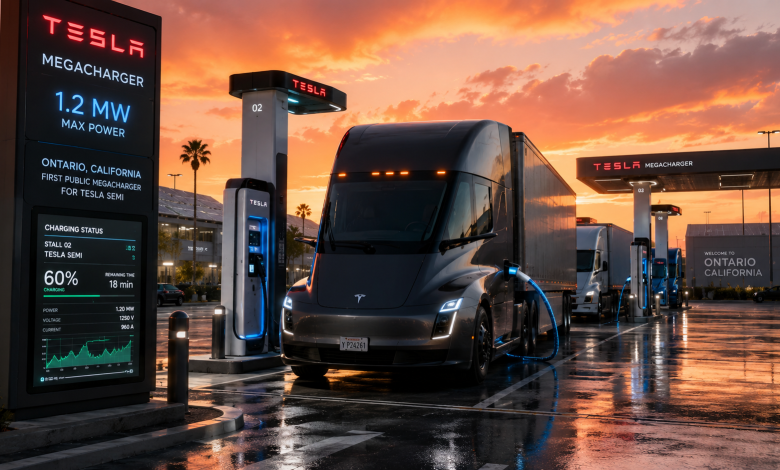
Tesla has officially opened its first publicly accessible Megacharger station for the Tesla Semi, marking a major milestone in the company’s effort to accelerate the adoption of battery-electric heavy-duty trucks.
Located at 4265 E. Guasti Road in Ontario, California, the charging hub is now available to Tesla Semi fleet customers, expanding access beyond Tesla’s own operations and early pilot partners. The launch represents a significant step toward building the charging infrastructure needed to support large-scale electric freight transportation.
First Public Megacharger Goes Live
Until now, Tesla’s Megacharger network has primarily served internal operations and select customers at locations such as Gigafactory Nevada and facilities near the Port of Long Beach.
The Ontario site is the first dedicated Megacharger station open to commercial Tesla Semi operators, providing fleets with access to ultra-fast charging designed specifically for Class 8 electric trucks.
The move signals Tesla’s transition from pilot deployments to broader commercial infrastructure.
High-Power Charging for Long-Haul Freight
The new station delivers charging speeds of approximately 750 kW, with Tesla’s Megacharger technology capable of scaling to 1.2 megawatts in future deployments.
According to Tesla, the charging system is designed to restore up to 60% of the Tesla Semi’s driving range in around 30 minutes, helping reduce downtime for commercial operators.
Fast charging remains one of the most important factors in making electric trucks practical for regional and long-haul logistics.
Nationwide Megacharger Network Expands
The Ontario opening is part of Tesla’s broader plan to establish a nationwide Megacharger network.
Earlier this year, the company updated its charging network roadmap to include more than 60 planned Megacharger locations across 15 U.S. states, targeting major freight corridors used by commercial trucking fleets.
Tesla expects to deploy dozens of additional sites over the coming years as Semi production ramps up.
Pilot Partnership Strengthens Charging Infrastructure
Tesla is also expanding its charging footprint through a partnership with Pilot Travel Centers, one of North America’s largest truck stop operators.
The collaboration will introduce Megawatt Charging System (MCS)-compatible charging stations along key interstate freight routes, including Interstate 5 and Interstate 10.
Each location is expected to feature between four and eight high-power charging stalls capable of delivering up to 1.2 MW, supporting faster turnaround times for commercial fleets.
Tesla Semi Production Gains Momentum
After years of delays following its original unveiling in 2017, the Tesla Semi is entering a broader production phase.
Manufacturing is centered at Tesla’s facility near Gigafactory Nevada, where the company aims to significantly increase production capacity over the coming years.
Early customers, including PepsiCo, have already been using the trucks in regional delivery operations, providing real-world data as Tesla prepares for wider commercial adoption.
Infrastructure Remains the Key Challenge
While battery technology has continued to improve, charging infrastructure remains one of the biggest obstacles facing electric heavy-duty transportation.
Tesla believes its growing Megacharger network will help address concerns around charging availability, range, and fleet productivity by providing reliable, high-speed charging along major logistics routes.
The company also offers Megacharger and Basecharger solutions for businesses interested in installing private charging infrastructure at warehouses and distribution centers.
What Comes Next?
As Tesla expands both Semi production and its nationwide charging network, industry analysts believe 2026 could become a turning point for electric freight transportation.
The success of the Ontario Megacharger hub and upcoming charging locations will play a critical role in determining how quickly commercial fleet operators transition from diesel-powered trucks to battery-electric alternatives.
With charging infrastructure finally beginning to scale alongside vehicle production, Tesla is positioning the Semi as a serious contender in the future of sustainable logistics.