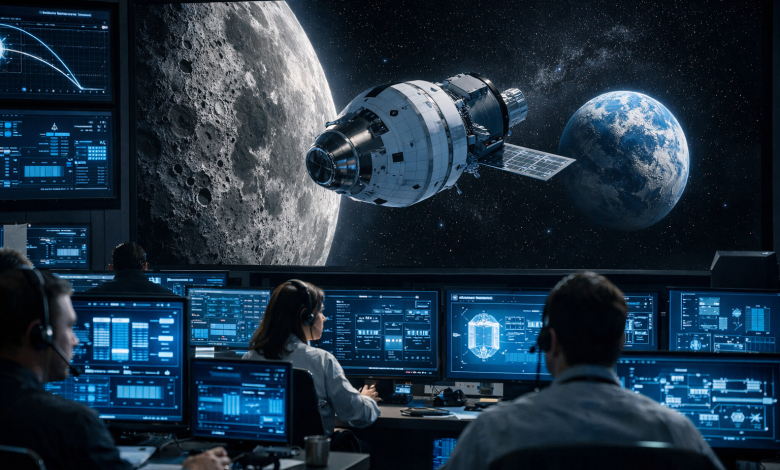
The long-anticipated return of astronauts to deep space has encountered a new technical hurdle, as NASA intensifies its review of a battery-related issue aboard the Orion spacecraft planned for the Artemis II mission.
Officials confirmed that engineers are closely examining irregularities observed within Orion’s power systems, specifically linked to battery performance during prior testing phases. While no immediate safety risk has been declared, the agency has emphasized that crew safety remains the overriding priority, prompting a thorough investigation before proceeding with launch preparations.
Artemis II, which aims to send four astronauts on a lunar flyby, represents a critical step in NASA’s broader Artemis program. The mission is intended to validate life-support systems, propulsion, and deep-space navigation ahead of future lunar landings. However, the latest development highlights the complexity of certifying spacecraft systems for human spaceflight after decades without crewed missions beyond low Earth orbit.
Engineering caution shapes timeline
The battery system in question plays a central role in Orion’s ability to sustain operations during critical mission phases, including launch, transit, and re-entry. Engineers are now analyzing whether the anomaly stems from manufacturing variability, integration challenges, or environmental stress during testing.
NASA has not formally announced a new launch date, but internal assessments suggest that the investigation could introduce additional delays to a mission already pushed back from its earlier schedule. Artemis II was previously targeting a late 2025 or early 2026 window, though that timeline now appears increasingly fluid.
Industry analysts note that such delays, while frustrating, are not unusual in human spaceflight programs. The scrutiny applied to Artemis II reflects lessons learned from past missions, where overlooked system vulnerabilities led to costly setbacks or catastrophic outcomes.
Strategic importance remains unchanged
Despite the uncertainty, Artemis II remains a cornerstone of the United States’ lunar ambitions. The mission will pave the way for Artemis III, which aims to return humans to the lunar surface for the first time since the Apollo era.
NASA leadership has reiterated that resolving the battery issue now is essential to ensuring long-term mission success. The agency is also coordinating with contractors and international partners to assess any broader implications for the Artemis architecture, including the Space Launch System rocket and supporting infrastructure.
For now, Artemis II stands as both a symbol of progress and a reminder of the engineering rigor required to extend human presence deeper into space. As the investigation continues, the mission’s timeline may shift, but its significance remains firmly intact.