For decades, passwords have served as the internet’s gatekeepers. They’ve also been one of its most universally hated features.
Everyone has forgotten one. Everyone has reset one. Everyone has stared at a login screen wondering whether the correct password ended with a number, a symbol, or some bizarre combination that seemed perfectly reasonable six months ago and has since disappeared into the void.
Entire industries have been built around helping people recover passwords they created themselves.
Despite the astonishing pace of technological progress, logging into an online account remains oddly primitive. We carry smartphones more powerful than the computers that helped land humans on the Moon, yet much of our digital security still depends on remembering a secret string of characters.
That may finally be changing.
Apple, Google, Microsoft, and a growing list of major online platforms are pushing passkeys as the successor to traditional passwords. The transition won’t happen overnight, but for the first time, the internet’s most annoying security feature appears to have a genuine retirement plan.
How Passwords Became Everyone’s Problem
When the internet was young, passwords made perfect sense.
If you knew the password, you got access. If you didn’t, you stayed out. Simple.
The problem wasn’t the technology. It was the humans using it.
As online life expanded, people suddenly found themselves juggling passwords for email, banking, shopping, social media, streaming services, work accounts, gaming platforms, and countless other websites. What started as remembering a handful of passwords quickly turned into managing dozens.
Predictably, people found shortcuts.
Some reused the same password everywhere. Others created passwords so obvious they could probably be guessed before a hacker finished their first coffee. Many stored them in documents with names like “Passwords_Final_Really_Final.xlsx,” which somehow felt secure enough at the time.
Security teams responded by making passwords more complicated. Suddenly users needed uppercase letters, lowercase letters, numbers, symbols, minimum lengths, and occasionally what felt like approval from an ancient cybersecurity deity.
What began as a simple security measure evolved into one of the internet’s most frustrating rituals.
The Password Arms Race Nobody Enjoyed
Things only got worse as data breaches became routine.
Over the years, billions of usernames and passwords have been exposed through hacks, leaks, and security incidents. Once stolen, those credentials often become keys to multiple accounts because many people reuse the same passwords across different services.
The result has been an endless security arms race.
Companies introduced stricter password requirements. Users adopted password managers. Two-factor authentication became standard. Security experts urged everyone to create longer and more complex passwords.
Attackers adapted just as quickly.
Everyone worked harder. Nobody had more fun.
The fundamental problem never changed. The internet was still asking humans to remember and manage dozens of unique credentials. History has repeatedly shown that people are remarkably capable creatures, but maintaining 37 different passwords may not be among our greatest talents.
Enter the Passkey
Passkeys are designed to eliminate many of the problems passwords created.
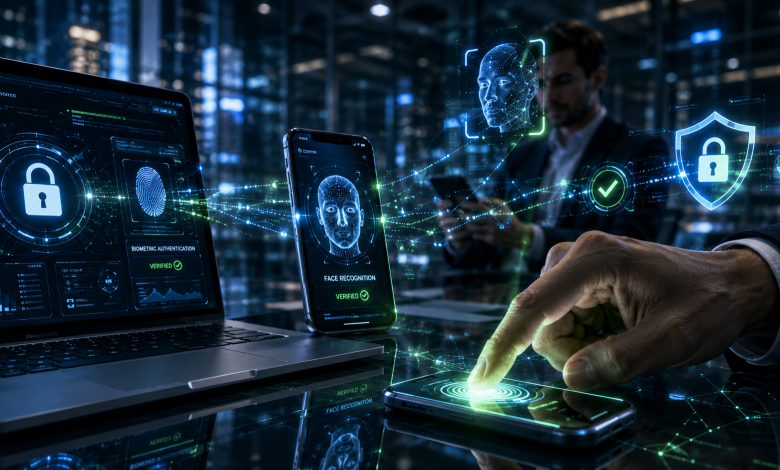
Instead of relying on something you know, passkeys rely on cryptographic credentials stored securely on your device. Rather than typing a password, users can authenticate using a fingerprint, facial recognition, or a device PIN.
For most people, that already feels familiar because it’s how they unlock their phones every day.
The real magic happens behind the scenes.
With passkeys, there is no traditional password sitting on a company’s servers waiting to be stolen. That makes phishing attacks far less effective and dramatically reduces the value of compromised databases.
If attackers breach a service, they can’t simply walk away with millions of reusable passwords because those passwords don’t exist in the conventional sense.
For security professionals, that’s a major upgrade.
For everyone else, it means fewer password resets, fewer authentication headaches, and fewer moments spent angrily insisting that a login screen is wrong.
Why Big Tech Is All In
The push toward passkeys isn’t just about security.
It’s also about convenience.
Every forgotten password creates friction. Every account lockout generates support tickets. Every compromised account damages trust and costs companies money.
Passkeys solve several of those problems at once. They’re generally more secure while also being easier to use.
That’s a rare combination in cybersecurity.
Historically, stronger security usually meant sacrificing convenience. More protection often translated into more steps, more complexity, and more frustration.
Passkeys offer something different: better security with less effort.
For technology companies, that’s an opportunity that’s hard to ignore.
Will Passwords Actually Disappear?
Not tomorrow.
The internet is enormous, and millions of websites still rely entirely on traditional passwords. Many organizations will need years to modernize their systems, and some legacy platforms may cling to passwords for the foreseeable future.
But the momentum is becoming difficult to ignore.
More websites support passkeys. More devices enable them by default. More users are already comfortable authenticating with fingerprints and facial recognition.
The transition will likely be gradual, but the direction seems increasingly clear.
Just as floppy disks, dial-up internet, and DVD collections slowly faded into history, passwords may eventually join the list of technologies people look back on with a mixture of nostalgia and disbelief.
The death of passwords has been predicted many times before. This time feels different.
The technology exists. The major platforms support it. The incentives are aligned.
Users want simpler logins. Companies want fewer security incidents. Security experts want stronger protections.
That doesn’t mean cybersecurity problems will disappear. Attackers will adapt, as they always do.
Still, a future without endless password resets and impossible-to-remember credentials is starting to look realistic.
After all, humanity has built reusable rockets, self-driving cars, and AI systems capable of holding conversations.
Surely remembering whether your password ended with an exclamation mark, a dollar sign, or both shouldn’t be the challenge that finally breaks us.