UK Plans Major Social Media Restrictions for Children Under 16

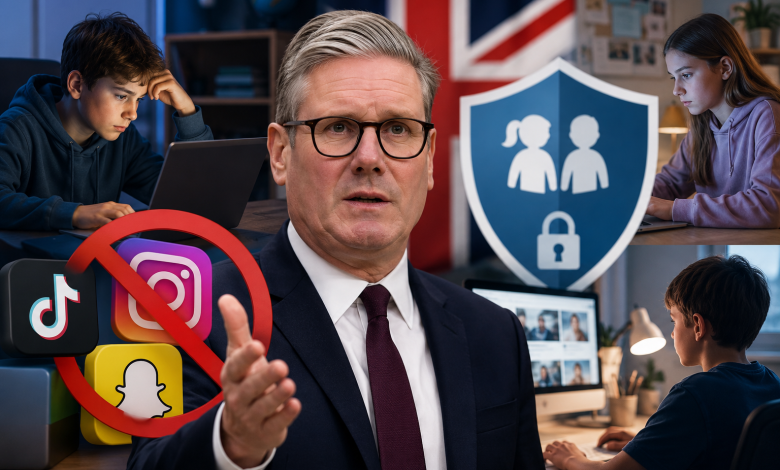
The UK government is preparing to introduce some of the toughest social media restrictions for children under 16 years, with Prime Minister Keir Starmer expected to unveil a new framework aimed at limiting how under 16s interact with online platforms. The proposed measures mark a major escalation in Britain’s efforts to protect young users from harmful content, addictive algorithms, online predators, and the growing mental health challenges linked to excessive social media use.
The announcement follows the government’s nationwide consultation, “Growing Up in the Online World,” which gathered more than 116,000 responses from parents, educators, healthcare professionals, technology companies, and young people. Officials say the overwhelming feedback demonstrated strong support for stronger protections, particularly as concerns continue to mount over the impact of social media on children’s wellbeing and development.
High Risk Platforms Could Become Off Limits
Under the proposed framework, children under the age of 16 could lose access entirely to social media platforms classified as “high-risk.” While the government has not yet published a definitive list, reports suggest major platforms such as TikTok, Instagram, and Snapchat could face stricter rules if regulators determine they expose younger users to elevated levels of harmful content or engagement-driven algorithms.
The proposal mirrors legislation introduced in Australia and signals a broader international shift toward stricter regulation of youth social media use. UK officials argue that platforms designed to maximize engagement often expose children to harmful material, encourage excessive screen time, and create environments where cyberbullying, grooming, and exploitation can flourish. By restricting access to higher risk services, policymakers hope to reduce these threats before they escalate into long term social and psychological problems.
New Limits on Features Designed to Drive Engagement
The government’s plans extend beyond outright platform bans. Children under 16 may also face restrictions on specific platform features even when they are allowed to use a service. Proposed limitations include bans on livestreaming, disappearing messages, and communication with unknown adult users. Regulators are also examining ways to reduce exposure to features that encourage compulsive usage, including infinite scrolling feeds, autoplay functions, and algorithmic recommendation systems.
Officials believe these design elements contribute significantly to excessive screen time and can increase the likelihood that young users encounter harmful or inappropriate content. Additional measures under consideration include digital curfews, daily usage limits, and enhanced age verification systems that could rely on facial age estimation or other identity verification technologies. The government aims to create an online environment where child safety takes precedence over engagement metrics and advertising revenue.
Support, Criticism, and the Road Ahead
The proposed restrictions enjoy substantial public support. Recent polling indicates that nearly nine out of ten UK parents favor stronger controls on social media access for children. Medical experts, child psychologists, and education leaders have also welcomed the government’s willingness to address what many describe as a growing public health issue. Supporters argue that social media companies have failed to protect young users adequately and that government intervention has become necessary.
Critics, however, question whether the measures can achieve their intended goals. Technology experts warn that teenagers may bypass restrictions through VPNs and other workarounds, while privacy advocates have raised concerns about age verification systems that collect biometric or identity data. Others argue that focusing on access restrictions alone does not address the deeper issue of platform design and business models that reward addictive behavior. Despite these concerns, the government appears determined to move forward, with implementation targeted before the end of 2026 as part of a broader online safety strategy. If adopted, the rules could reshape how millions of young people across the UK experience the internet and may influence similar legislation in other countries.