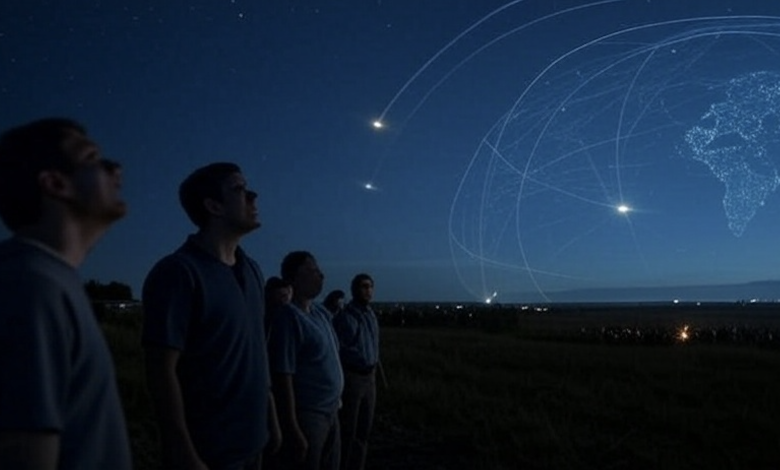
On July 25, 2025, SpaceX’s Starlink, the world’s largest satellite internet provider, suffered a rare and widespread global outage, leaving millions of users across 130 countries disconnected for over two hours. The incident, traced to a failure in core internal software services, disrupted everything from rural internet access to critical military communications in Ukraine. As Starlink cements its role as a cornerstone of global connectivity, the outage has sparked urgent questions about the resilience of satellite-based networks and their growing centrality to digital infrastructure.
A Global Blackout Felt Instantly
The disruption struck at approximately 3:15 PM ET on July 25, with user reports surging on platforms like Downdetector, which recorded over 61,000 complaints at the outage’s peak. From remote farms in the United States to military outposts in Ukraine, the impact was immediate and far-reaching. NetBlocks, a network monitoring group, reported connectivity dropping to 16% of normal levels, a stark indicator of the outage’s severity.
Social media platforms, particularly X, buzzed with frustration, with one user quipping, “Starlink’s down? Guess I’ll talk to my cows instead.” Others highlighted more serious disruptions to remote work, education, and emergency services.
In Ukraine, where Starlink powers over 50,000 terminals critical for battlefield operations, the outage was particularly disruptive. Ukrainian commander Robert Brovdi reported that service was “down across the entire front,” halting drone coordination and combat communications for over two hours.
“If you rely on Starlink for frontline surveillance, you’re effectively blind during an outage,” said Taras Tymochko, a signals specialist with Ukraine’s military. The incident underscored Starlink’s pivotal role in modern warfare and the risks of over-reliance on a single provider.
The Cause: A Software Failure
SpaceX responded promptly, acknowledging the issue on X at 4:05 PM ET. By 6:23 PM ET, Michael Nicolls, Starlink’s Vice President of Engineering, announced that the network had “mostly recovered” after approximately 2.5 hours. Nicolls attributed the outage to a “failure of key internal software services that operate the core network,” dismissing speculation about satellite or hardware malfunctions.
While SpaceX has not released a detailed technical report, discussions on platforms like Reddit suggest a botched software update may have disrupted the satellite mesh network’s inter-satellite and ground-station communications.
Gregory Falco, director of the Space and Cybersecurity Laboratory at Cornell University, likened the incident to the 2024 CrowdStrike outage, which paralyzed 8.5 million Windows devices due to a faulty update.
“This looks like a bad software push, possibly compounded by insufficient testing,” Falco told Reuters. “It’s not entirely unlike CrowdStrike, though a cyberattack can’t be ruled out.”
While SpaceX has not confirmed any malicious activity, the timing, coinciding with the rollout of Starlink’s Direct-to-Device (D2D) service with T-Mobile, has fueled speculation that new integrations may have strained the network’s software infrastructure.
A Test of Starlink’s Meteoric Rise
Starlink’s constellation of over 8,000 low-Earth orbit satellites has transformed internet access since its 2019 debut, delivering high-speed connectivity to more than 6 million users worldwide. With median download speeds approaching 200 Mbps in the U.S. as of July 2025, according to SpaceX data, the service has become indispensable for rural communities, maritime industries, and military operations.
Yet, the outage revealed a critical vulnerability: the centralized software systems managing the network create a single point of failure, undermining the decentralized promise of satellite internet.
“This is likely the longest outage Starlink has faced since becoming a major provider,” said Doug Madory, an internet analysis expert at Kentik.
The disruption affected not only individual users but also businesses, governments, and emergency services in regions like Australia, where Starlink serves 200,000 users, and Africa, where its expansion has been rapid. In the Philippines and parts of Southern Italy, some users reported intermittent issues persisting into July 26, suggesting a staggered recovery.
Elon Musk, SpaceX’s CEO, issued a rare public apology on X: “Sorry for the outage. We’re working to ensure this never happens again.” Nicolls echoed this, promising a “root-cause analysis” and enhanced software testing protocols. However, the incident has raised concerns about Starlink’s scalability as it pursues ambitious goals, including a constellation of over 34,000 satellites and integration with 5G networks via D2D services.
Implications for the Future
The outage arrives at a critical juncture for Starlink, which is projected to generate $9.8 billion in revenue for SpaceX in 2025. Its expansion into new markets and partnerships, such as T-Mobile’s T-Satellite service launched on July 24, underscores its growing role as critical infrastructure. However, the incident highlights the need for robust redundancies and decentralized systems to prevent future failures.
Competitors like Amazon’s Project Kuiper and OneWeb could capitalize on this misstep by emphasizing more resilient network architectures. For regulators, the outage raises questions about oversight of satellite internet as a public utility. The U.S. Federal Communications Commission (FCC) may push for stricter reliability standards, particularly as Starlink supports military and emergency communications. In Ukraine, where the service has been a lifeline since Russia’s 2022 invasion, the outage revived concerns about dependency on a single provider, especially after reports of Musk unilaterally restricting service during a 2022 Ukrainian offensive.
A Resilient Path Forward
SpaceX’s rapid recovery, restoring service within hours, demonstrates its technical agility, but the July 25 outage serves as a wake-up call. As Starlink continues to redefine global connectivity, its ability to deliver on promises of “highly reliable” service will hinge on addressing software vulnerabilities and building redundancies into its sprawling network.
For millions of users, from remote farmers to frontline soldiers, the stakes could not be higher. The incident may be a fleeting disruption in Starlink’s ascent, but it underscores a universal truth in the tech industry: even the most transformative systems are only as strong as their weakest link.
As SpaceX works to fortify its network, the world will be watching to see if it can deliver the unbreakable connectivity it promises.