SpaceX IPO Raises $75B, Hits $1.77T Valuation on Nasdaq

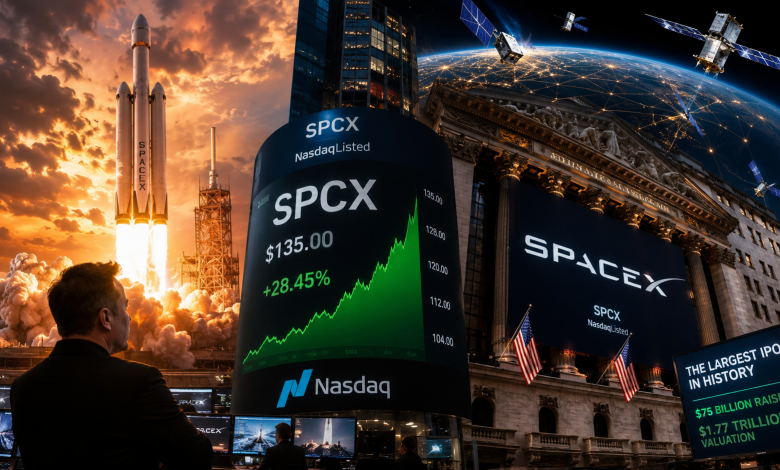
SpaceX Goes Public in Historic $75 Billion IPO, Reaches $1.77 Trillion Valuation. Space exploration giant SpaceX has officially entered the public markets in what is being hailed as the largest initial public offering in history.
The company priced its highly anticipated IPO at $135 per share, raising approximately $75 billion and achieving a staggering $1.77 trillion valuation. Shares are expected to begin trading on the Nasdaq under the ticker SPCX, marking a pivotal moment not only for SpaceX but for the entire commercial space industry.
The historic debut eclipses the previous IPO record set by Saudi Aramco in 2019 and signals growing investor confidence in the future of space infrastructure, satellite communications, and next-generation aerospace technology.
A Record-Breaking Market Debut
SpaceX sold roughly 555.6 million shares at a fixed offering price of $135, generating unprecedented demand from both institutional and retail investors.
Reports suggest retail investors alone submitted more than $70 billion in orders, while total demand reportedly surpassed $250 billion, making the offering heavily oversubscribed.
The IPO also reflected Elon Musk’s unconventional approach to finance. Rather than relying entirely on traditional Wall Street pricing mechanisms, SpaceX adopted a fixed-price structure and reserved a significant portion of shares for retail participation, giving everyday investors greater access to one of the world’s most sought-after private companies.
Following the offering, Musk is expected to maintain majority voting control, preserving his influence over the company’s long-term vision and strategic direction.
The Business Behind the Valuation
Investors are not simply buying into a rocket company. They are investing in an ecosystem that spans satellite internet, government contracts, commercial launches, and future space infrastructure.
Starlink Continues to Expand
SpaceX’s Starlink satellite internet network has become one of the company’s strongest revenue drivers, serving millions of customers worldwide and generating recurring cash flow that supports broader expansion efforts.
Dominance in Launch Services
The company’s reusable Falcon 9 rockets have transformed the economics of spaceflight, dramatically reducing launch costs while securing major contracts from NASA, defense agencies, and private enterprises.
Meanwhile, Starship remains central to SpaceX’s ambitions for deep-space exploration, lunar missions, and eventual Mars colonization.
Emerging Opportunities
SpaceX is increasingly positioning itself at the intersection of artificial intelligence and space infrastructure. Analysts point to potential opportunities in orbital computing, space-based data centers, advanced communications networks, and collaborations with Musk’s expanding AI ecosystem.
Financial Performance and Investor Sentiment
SpaceX reported approximately $18.67 billion in revenue last year, representing year-over-year growth of roughly 33%.
Despite strong revenue expansion, the company recorded a net loss between $4.2 billion and $4.94 billion, largely due to aggressive investments in research, development, AI initiatives, and Starship deployment.
At its IPO valuation, SpaceX is trading at a premium multiple relative to traditional aerospace companies, highlighting investor expectations for substantial long-term growth.
Market analysts remain divided.
Some believe SpaceX is uniquely positioned to become the foundational infrastructure provider for the emerging space economy, while others caution that the company’s valuation already prices in years of future success and leaves little room for execution errors.
A New Generation of Space Wealth
The IPO is also expected to create thousands of new millionaires among current and former employees who received stock-based compensation during the company’s private years.
Retail investors have gained broader access through platforms offering IPO participation, a notable departure from many previous mega-cap listings that were dominated by institutional buyers.
Whether SPCX experiences a dramatic first-day rally or a more measured debut remains one of the biggest questions facing the market today.
What Comes Next?
SpaceX’s public listing marks a major milestone in the commercialization of space.
A successful market debut could accelerate investment across the broader aerospace sector, increase competition among private space companies, and further strengthen Elon Musk’s influence across technology, artificial intelligence, transportation, and space exploration.
As trading begins, investors will closely monitor market reaction, analyst price targets, and the company’s ability to deliver on its ambitious vision for the future.
One thing is clear: SpaceX’s IPO is more than a financial event. It represents a turning point where the worlds of capital markets, advanced technology, and space exploration converge on an unprecedented scale.
The next chapter of the space economy has officially begun.