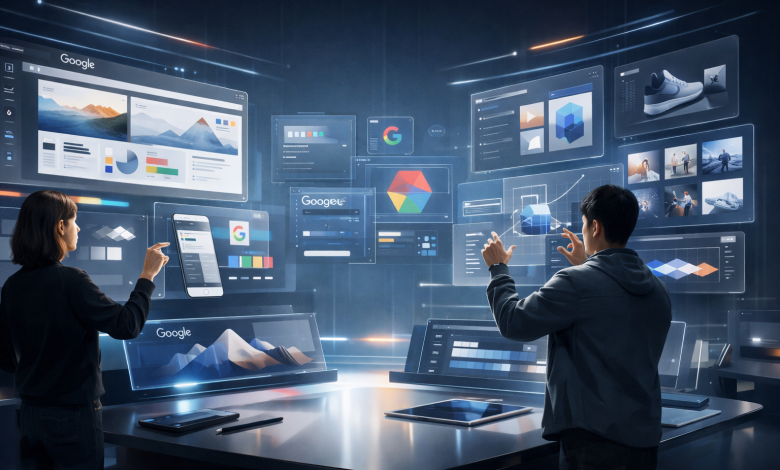
Google has formally pushed its experimental AI design platform, known as Stitch, into the spotlight, introducing a new workflow centred on what it calls “vibe designing.”
Developed within Google Labs, Stitch allows users to generate full user interface designs for web and mobile applications using natural language prompts, images, or even voice input. Rather than constructing layouts element by element, users describe the desired feel or outcome, and the system produces high fidelity screens almost instantly.
The concept marks a sharp departure from traditional design tools such as Figma and Adobe, which rely on manual composition and structured workflows.
From structure to intent
At the core of Stitch is a rethinking of how digital products are conceived. Instead of beginning with grids, components, and layouts, designers start with intent. A simple prompt describing a product’s tone or user experience can generate multiple complete interface directions within seconds.
The platform functions as what Google describes as an AI native canvas. Users can combine prompts, screenshots, and references in a fluid workspace, with the system continuously generating and refining outputs. This allows rapid exploration of ideas before committing to a specific structure or design system.
Stitch also extends beyond static mockups. It can produce interactive prototypes and export production ready front end code, positioning it as a bridge between design and development workflows.
Competitive pressure builds
Google’s move places Stitch in direct competition with Figma, long considered the industry standard for collaborative interface design. Adobe, which has been embedding generative AI into its creative suite, also faces renewed pressure as AI first tools begin to reshape expectations.
What differentiates Stitch is its emphasis on speed and accessibility. By lowering the barrier to entry, the tool opens design capabilities to non specialists such as founders and developers, while accelerating early stage ideation for professional teams.
However, analysts note that traditional platforms still hold an advantage in precision, design systems, and team collaboration. Stitch is likely to complement rather than fully replace existing tools in the near term.
A new phase for digital creation
The emergence of Stitch underscores a broader transformation in software, where AI shifts the user’s role from executor to director. Designers increasingly define outcomes while systems handle implementation.
This evolution raises questions about originality and creative control, particularly if AI generated interfaces begin to converge around similar patterns. At the same time, it reinforces the importance of human judgement in shaping product identity and user experience.
With Stitch, Google is signalling that design is becoming a central battleground in the next wave of computing. As AI continues to compress the gap between idea and execution, the tools that define creativity itself are being rewritten.