AI Hardware Surge Accelerates As Nvidia Expands Asia Push And TSMC Signals Price Pressure

Deepening partnerships and rising chip costs point to a prolonged infrastructure boom
The global race to build artificial intelligence infrastructure is entering a more intense phase, as Nvidia strengthens its footprint across Asia and TSMC signals continued pricing power amid relentless demand for advanced chips.
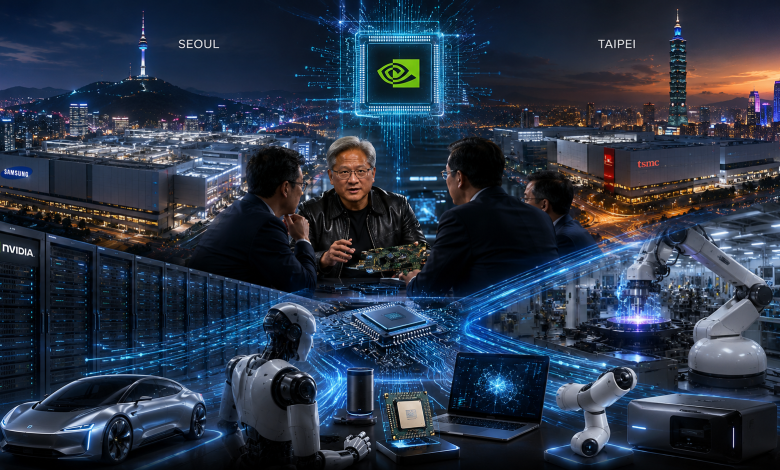
Nvidia CEO Jensen Huang is set to visit South Korea this week, marking his fourth trip to the country in just six months. The visit includes high-level meetings with executives from SK Group, LG Group, Naver, Hyundai Motor Group, and Samsung, underscoring the strategic importance of the region in the next stage of AI development.
The trip follows a series of high-profile appearances across Asia, including events in Taipei, where Nvidia outlined its vision for expanding AI capabilities beyond data centers into robotics, physical AI, and next-generation computing systems. Industry sources say Huang’s repeated visits reflect a deliberate push to deepen ties with key manufacturing and technology partners, particularly in memory and advanced packaging.
South Korea plays a critical role in the AI supply chain, especially in high-bandwidth memory, a key component for training and running large AI models. Strengthening collaboration with Korean firms positions Nvidia to secure the resources needed to sustain its rapid growth.
At the same time, Taiwan Semiconductor Manufacturing Company is signaling that the supply side of the equation will remain tight. Chairman and CEO C.C. Wei told shareholders that demand for AI chips continues to exceed expectations and indicated that the company is considering further price increases.
While Wei emphasized a measured and sustainable approach, the message was clear. Advanced semiconductor capacity is becoming more valuable, and customers should expect rising costs as the industry scales to meet AI-driven demand.
TSMC is maintaining an aggressive growth outlook, forecasting revenue expansion of more than 30 percent in 2026. The company plans to invest between $52 billion and $56 billion in capital expenditures, one of the largest spending programs in its history, aimed at expanding leading-edge manufacturing capabilities.
Adding to the momentum, Nvidia recently introduced its RTX Spark superchip, designed to power a new category of AI-native personal computers. These systems are built to run autonomous AI agents locally, marking a shift from cloud-dependent models toward more distributed intelligence at the edge.
Major hardware partners including ASUS, Dell, HP, Lenovo, Microsoft, and MSI are expected to launch devices based on the platform later this year. With performance reaching up to one petaflop, these machines are positioned as collaborative systems capable of acting as active digital assistants rather than passive tools.
Together, these developments highlight a broader transformation underway in the semiconductor industry. Demand from hyperscale data centers remains strong, while emerging categories such as on-device AI and robotics are adding new layers of pressure to an already constrained supply chain.
For industry leaders like Nvidia and TSMC, the dynamic is reinforcing their dominance. For the rest of the ecosystem, it raises the stakes, as access to advanced chips becomes both more critical and more expensive.
Analysts increasingly view the current environment not as a short-term surge, but as a sustained supercycle that could extend well into 2027 and beyond.